
Le Service pour la science et la technologie de l’Ambassade de France en Allemagne met en lumière des femmes scientifiques et des managers de projets, en particulier des coopérations franco-allemandes scientifiques féminines, contribuant ainsi à la déclinaison par l’Ambassade de France en Allemagne de la stratégie internationale de la France pour une diplomatie féministe (2025-2030). Plus d’informations : https://de.ambafrance.org/Strategie-internationale-de-la-France-pour-une-diplomatie-feministe-2025-2030
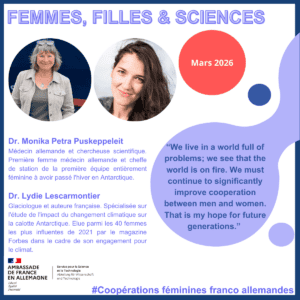
Dr.med. Monika Petra Puskeppeleit MPH est une médecin allemande, gestionnaire de soins de santé et chercheuse scientifique qui s’intéresse particulièrement à la médecine dans les régions reculées, notamment dans les régions polaires. Elle est la première femme médecin allemande et cheffe de station de la première équipe entièrement féminine à avoir passé l’hiver en Antarctique. Elle fait partie du Explorers Club de New York et est ambassadrice de l’IAATO pour l’Antarctique.
Lydie Lescarmontier est une glaciologue et auteure française. Elle est spécialisée sur l’étude de l’impact du changement climatique sur la calotte Antarctique. Elle a été élue parmi les 40 femmes les plus influentes de 2021 par le magazine Forbes dans le cadre de son engagement pour le climat.
Can you introduce yourselves?
Monika Puskeppeleit: My name is Monika Puskeppeleit. I come from Germany. Recently I am working in Switzerland as a specialist in occupational health, but I am living partly also in Norway, in the land of the famous polar researchers. My background was from the beginning led by my dream to do an overwintering in the Antarctic. When I was a young medical student, I saw a movie about the McMurdo, Wintering in late 1970s. I cannot really explain why, but from this moment I had this goal, an Antarctic wintering. At that time the Alfred Wegener Institute for Polar and Marine Research (AWI) at Bremerhaven was not established. Two days after completing my medical studies in 1984, I directly went to the AWI and I asked for the director, Professor Gotthilf Hempel. I explained to him that I would like to spend the winter at the German Antarctic. research station. He looked at me and he answered, “In this century, there will be no possibility for women to do this”. Nevertheless, he supported me immediately, because he sent me further to the German Society of Polar Medicine. I got contact there, and I have also contacted the Australian Antarctic Division. I knew that I would go with the Australians if the Germans did not send any woman to the ice. In the meantime, I began to study all kinds of topics related to medicine in extreme environments, while I was working in surgery, emergency medicine and anesthesiology. I wanted to get a broad medical education, because at that time the requirements for going to Antarctica as a doctor were not yet very clearly defined. My big break came in 1986. At the time, I was working as an assistant doctor in neurosurgery at a hospital near the Danish border. Alongside this work, I was involved in polar medicine, studying changes in the human immune system during long-term stays in Antarctica. I knew at the time that research was being conducted on this topic at Russian Antarctic stations. Equipped with the original Russian publications, I first had to find a Russian translator. After that, in 1986, I gave my first international scientific lecture at the International Polar Conference at Bremerhaven on polar medicine. And now chance came into play, because in 1988 two other young female scientists had also shown great interest in spending the winter there. Our German Minister of Research, Professor Heinz Riesenhuber, decided that Germany would be the first nation to send women to the Antarctic ice. At the end of 1989, we took part in this very exciting women’s winter expedition, which was of great significance for the history of polar research. That’s a brief insight into my career.
Lydie Lescarmontier: My name is Lydie Lescarmontier. I started with environment studies. I was really focused on the fact that I wanted to work for the environment, but I never thought about going to glaciology. I was probably missing some models that did that and I didn’t feel like I was able to do that. I started my studies in an engineering school in France, in environment, but very quickly, I was really bored by what I was doing. I stopped for a year and I tried to do a master on oceanography and meteorology. At the end of the master, I had the possibility to do an internship in a research laboratory and I found one internship that was focused on glaciology. They were still looking for someone. It was pretty late in the application system, but I went there. The head of the research team told me, I don’t know if there are any applicants because I am not communicating with the researcher, but I can get your name and I will come back to you. The researcher was at a polar station, and at that time you could not send documents, just send a text message. He received a lot of applications, but he had never seen any CV or motivation letter. I was pretty much the only one that applied for the job because I met in person someone and they said, okay, so you can start and we see how it goes. I started working on glaciology, working on data that were collected on the glacier Mertz in Antarctica. At the end of the internship, my supervisor asked if I wanted to keep on going on a thesis, but he said “The only condition is that you have to go to Antarctica in two weeks’ time”. I said, yes, I want to do that. I was really, really lucky because unlike Monika, I didn’t push for it. I arrived at the right moment with the right person. I thought I was going there as a scientist and I would collect my data and then go back to the lab. I thought that the journey was really focused on the science. But looking at it from my point of view today, I can say that the journey was really focused on actually the environment, the people I would meet there, to live a proper adventure, something I was not aware I would live. I did my thesis for four years, and I was really lucky to get back to Antarctica every year to collect data. So not all the missions I did there actually worked. We had a lot of different issues: we got stuck in the ice one year for two months; we had an accident, so I lost some colleagues… A lot of things happened during these four years, but I managed to get my PhD. Then I went to Australia, and I worked there as a researcher for a few years as well. It was also a chance for me to get to other places in Antarctica. Actually, the Australian have four stations in East Antarctica, so I was lucky to go to most of them and do a lot of field work. This was just the first part of my career. I finished my PhD in 2012, and was in Australia until 2020, and I was witnessing the changes that happened in Antarctica. Although it is harder than in the mountains to see the changes because you have so much ice, I was still able to see it and I had some colleagues, like meteorologist that were collecting data that were saying “Oh, my God, climate change is really starting now”. I felt like I had to do something that was more than just witnessing what was happening. It was really hard for me as a scientist to write paper and do conferences, but just in my own network and for people that were already convinced. I thought I really have to work with the general public and make them aware of what is going on and explain why the polar regions are so important. That is when I had my shift from my research to what I am doing today, which is more education on climate change. I started working in associations, and then I joined the UNESCO Center where I was Educator on Climate Change. I worked with different ministries of environment on education to change the school curriculum of kids and to introduce climate change in their program. Now, I am working as a consultant for the city of Bourges, who will become the capital of culture in 2028. So how they can use that opportunity to actually work on the transition.
Did you face difficulties as women when you went to the Antarctica?
Monika Puskeppeleit: First, we had to complete survival training in the Austrian Alps. At the time, the institution considered it impossible to send mixed teams to Antarctica. The Australians were very open to the idea and had already sent a female station leader to the ice. In Germany, however, they were very conservative. You must imagine that polar research was a male-dominated, polar-hero bubble. The question was always: “What on earth are these women doing there?” But I knew that I could only gain a foothold there through scientific contributions. Scientific questions concerning polar medicine weren’t really considered during the wintering expeditions or other expeditions of that era. Germany would have been the first nation to send an all-female overwintering team to the ice for 14 months. We had to be twice as good as our male colleagues, that much was clear. At the German overwintering station, the team consisted of four female scientists, two meteorologists, two geophysicists, and the technical team: two engineers for operating the base, a cook, a radio operator, and the expedition doctor, who was also the station’s commanding officer. We were nine women, eight meters below the ice at the end of the world. I will never forget the moment I set foot on the icy ground of the Georg von Neumayer Station in Antarctica. I had carried out my planned research project; I was very interested in the immune system and was therefore conducting a study on the T-cell immunity of overwintering expedition members. I also made some changes there because the nine male overwintering doctors before me hadn’t conducted any polar medical research studies. Nowadays, of course, there are medical research projects there, which I’m very happy about. I only regret that sociopsychological isolation studies couldn’t be carried out back then. These results would certainly have been very interesting for my colleagues in space medicine. There were already inquiries from polar psychologists at the time, because nobody knew exactly how nine women would react to nine months of isolation in Antarctica. During those nine months of isolation, no ship came, there was no social media, only possible radio contact with other Antarctic stations, so we were truly isolated. However, an official psychological study was rejected by those in charge at the Alfred Wegener Institute (AWI). I think they wanted to protect us at the time. When we, the nine women, arrived, we met the nine men of the official overwintering group, who had already completed their isolation. The first two months, which were for settling in at the station, weren’t always easy for us, as we didn’t always have the same mindset as our male overwintering colleagues: We women were very team-oriented, and I had internalized a corresponding leadership style. For example, during my training as station manager, my former medical colleague explained to me that no one other than him and the radio operator entered the radio room. Later, when I was leading my all-female team, each of us could use the radio in an emergency, and anyone could enter the radio room and learn how to operate it.
Lydie Lescarmontier: The first time I went, there were three women on the boat and 45 men. We had a cabin to ourselves, and one of the women was the daughter of a scientist who was on the boat. I realized that there were very, very few women. I also spent several months at the Australian Mawson-Station, and we were two women for about fifteen men. The first time I went to Antarctica was in 2008, it is true that it is not very far, but at the same time it has been almost 20 years, and it has changed enormously. Monika said it: today, there is accessibility, there are social media, etc., that give a lot more visibility to all this and we now have women who show that they went there, that they did this type of work, etc. But, as I was one of the few women at that time, I think it was an asset, in the field, not as a scientist. For the Australians, there is a lot more parity, it was more normal. For the French, it was still something a little anecdotal, a bit funny, like “There are girls who are with us, we are going to help them a little bit because they look a bit lost”. Although that is pejorative, I have to say that in the field, I had a lot of help and attention. In a way it was a good advantage in terms of contacts with people. Maybe I could do things that I would not have been able to do if I had been a man because there was more competition, I don’t know. However, I been harassed by some people who were not at all used to going to Antarctica when I was working with the Australians. For example, there was an artist who had been invited for an artist residency and who, I think, had not at all the awareness of what it is to work in an isolated environment, to be far away from one’s family for a long time, etc. I would not have dealt with harassment if I had been a man. But in general, if I look at these 10 years of research, I have done a dozen expeditions. If we were to ask me, tomorrow, “Do you come back tomorrow?” I would, of course, go back. If in the field in the Antarctica being a women had some positive aspects, as a scientist, in the laboratory, it was more complicated. I can say that there is still a difference today, because I think that, in general, we trust more people who are men than women. I think that women still need to fight twice as strongly as scientists and to prove twice their value. I felt that there was really a need to fight hard to make one’s place as a scientist. I have colleagues, when I started to work in the Polar region, who weren’t that old but who told me, “I’ve known the work on the station, it was non-mixed.” I also heard people say, it was better when there were only men, it was simpler, we had less problems. And others say, on the contrary, “it is much better when there are women because it forces us to take care of ourselves”. But I think that it is a huge asset to have parity.
Monika Puskeppeleit: When you consider what our women’s team accomplished in the 1990s, it’s clear that we still haven’t received the corresponding official recognition. I hope that all my team members will one day be honored for their work; we pioneered research in Antarctica. It’s still evident that while we were sent out back then, we were subsequently kept in the shadows. Even today, the percentage of women in Germany, at least at the German Neumayer Station, will be below 50% in 2025. I dream that this will change. We live in a world full of problems; we see that the world is on fire. We must continue to significantly improve cooperation between men and women. That is my hope for future generations.
Lydie Lescarmontier: But something I was quite pleased to see actually in the French and in the Australian stations is that we see more and more women involved into jobs that are not just scientific jobs. Because at my time, we had women doctors and we had women scientists, usually working on penguins or whales or seals. They were really focused on a biology topic. But you could not see a woman cook or a woman plumber or welder. It is something actually that is changing today. We talk here about women in STEM, and I think it is really important to see more and more women into STEM, but also in these other jobs. Sometimes when I talk to young women that want to go to Antarctica, I am always asking them “Do you want to work as a scientist for glaciology or for polar biology or polar medicine? Or do you want to go there to have the experience of the polar environment? What is your goal at the end? Because what you can do is another job like welder, for example.” It is nice to see those changes at different level.
Are you engaged for women in science?
Monika Puskeppeleit: I try to support young female scientists and integrate them into research projects. For example, there’s currently a brilliant young scientist who would like to spend the winter there. I’ve tried to support her, exchange ideas with her, and offer advice. She’s not a physician but comes from a different field. Young doctors, both women and men, also contact me.
Lydie Lescarmontier: I am trying to give visibility to women that actually go on the field, something I didn’t have when I was a student. Like you said, Monika, we have these models of polar heroes, Ernest Shackleton for example, and but we don’t have any images of a woman or young woman that would go to Antarctica. Students get in contact with me just to find the right path and I explain a little bit what I have done. But it is a bit passive for me. It is not something I have been really involved, even if I think that is really important.
How should individuals approach their work or experiences in the polar regions, and what responsibilities do they have toward the environment and society?
Monika Puskeppeleit: We had been the first overwintering team ever who tested wind energy in the Antarctic. One of the engineers, she brought the pilot- project with her. The aim of the project was to use wind energy for the station’s energy supply so that we would not have to consume as much Arctic diesel fuel at that time, but we didn’t know, if it would work. But at least we planned to change the dimension a little. Here a small example, during our stay, we changed the waste disposal system at the time because we brought all the rubbish back. They said, “These women are changing everything. What’s the point? It won’t work. They’ll be buried in the trash.” But it did work. You can imagine how difficult it was, not just to be a woman, but also to change systems and bring new ideas into that atmosphere steeped in heroism. But I also want to say that, given climate change and all the current world events, it’s a great privilege to have the opportunity to travel there, to work and do research. That’s why you should bring something home that can help make the world a better place.
Lydie Lescarmontier: People that want to experience the polar region today, but I think we owe the region something. In our society today we want to collect experiences and want to tick the box. In tourism, for example, I can hear “I want to go to the seventh continent, and like that I have done them all, and I am happy about it”. I think we also have to change a little bit the way we think. We have to be engaged today. It is not just about us building our own little story. It is also, especially in that context of climate change, what we bring to society. It has to be over just our little person. It is something we are losing a little bit, especially in that social media area where you just show pictures of yourself doing that and that and that. It is all about us. But I think we really have to change that point of view and be more focused on what we can bring to society.
What advice would you give to young girls and women?
Lydie Lescarmontier: I always say that you can do pretty much whatever you want. You just have to be passionate about it. Today, I think everything is getting a bit harder for women. We have opened a lot of doors, like Monika did. But even if they are open, I think things get harder and harder. I always say I have been lucky, but I have always been very curious and very passionate about what I am doing. Even if it’s not working, I always push for it. I wanted to do education and communication. My background was in glaciology, so I worked for years for free for schools and for museums. I offered just free work to be able to learn that new job. At some point, I was good at doing that so someone was willing to pay me for doing it. I think if you just push it, push it, push it, and you really want to do it, you will manage. It is something I have seen so many times with people that went to Antarctica. Like Monika, I had a friend, she applied for going there as a biologist for 10 years. Each year, she was doing a new internship or she had a new experience that was building a CV. At some point, she managed to go there because she was the best for that.
Monika Puskeppeleit: I agree with Lydie one hundred percent. You must bring passion, fire and ice within yourself. But it’s also important to network, to engage with each other. In the age of the internet, the World Wide Web, etc., this is becoming much easier. Start networking, exchanging ideas, even beyond your own discipline, and cross boundaries. Look at what other departments are doing, what they are like, and be international. That is also important. Polar research is international.
Entretien réalisé par Julie Le Gall, Noela Müller, le 20 novembre 2025.
Rédaction : Noela Müller.
Mise à jour : le 10 mars 2026.