
Within the joint call “Development of the hydrogen pathway for the future energy mix”, the German Federal Ministry of Research, Technology and Space (BMFTR) and the French Ministry of Higher Education, Research and Space (MESRE) via the French National Research Agency (ANR) are funding five innovative projects that provide solutions to key challenges in the development of a hydrogen economy. One of these projects is MINDSET_Clean_H₂ (Modeling Infrastructure Development and Strategies for Expansion of Trade for Clean H2), whose German and French coordinators, Prof. Svetlana Ikonnikova and Prof. Olivier Massol respectively, told us more about the aim of this project. Enjoy the read!
The research environment
1) Can you introduce yourself as a researcher?
Svetlana Ikonnikova and Olivier Massol: There are three principal investigators (PIs) of the project MINDSET_Clean_H₂, who are economists working in close connection with scientists from other disciplines, especially engineers, to address the challenges of and help progress the energy market transformation.
German side of the project is represented by:
- Svetlana Ikonnikova, who specializes on Resource Economics at the Technical University of Munich (TUM) and serves as a Research Director of the TUM Center for Energy Markets. She combines analytical economic modeling with techno-economic simulation and machine learning to understand national and global resource markets and navigate the clean energy transitions.
- Franziska Holz, who leads the Resource and Environmental Markets research division at the German Institute for Economic Research (DIW Berlin) and is an Associate Professor at the Norwegian University of Science and Technology (NTNU). She has extensive expertise in modeling competitions and strategic interactions in energy markets helping develop critical policy insights supporting the adoption of clean energy solutions. Prof. Holz is fluent in French.
French side is represented by:
- Olivier Massol, who is a Professor at CentraleSupélec (University Paris-Saclay), where he co-directs the Sustainabale Economy Research Group at the Industrial Engineering Laboratory (LGI). His work focuses on the economics of energy markets and infrastructure. Over the last two decades, Prof. Massol has built strong academic ties with German colleagues through regular exchanges and conferences.
All three PIs share a long-standing commitment to Franco-German collaboration and a passion for interdisciplinary research connecting economics, engineering, and policy.
2) In what scientific environment do you evolve?
Svetlana Ikonnikova and Olivier Massol: The project brings together three distinct yet complementary education and research environments:
- A French “grande école” (CentraleSupélec) that is part of University Paris-Saclay, France’s leading research University,
- A German university (TU Munich), and
- A German research institute (DIW Berlin, member of the Leibniz Association).
All the three teams specialize in energy economics and market modeling while integrating engineering and policy dimensions. Each group maintains strong international networks beyond the Franco-German context, including partnerships with the University of Texas at Austin, the Norwegian University of Science and Technology, and the Japanese Institute for Energy Economics.
This diverse and dynamic environment enables interdisciplinary, data-driven research addressing both long-term and short-term aspects of global hydrogen market development.
Presentation of the project
3) Can you present us your scientific project in the field of hydrogen?
Svetlana Ikonnikova and Olivier Massol: The project MINDSET_Clean_H₂ develops an open-source suite of models that align the European Union’s hydrogen strategy with global market developments. It aims to provide stakeholders and policymakers with analytical and numerical tools to navigate the emerging hydrogen economy.
Three main research pillars define the project:
- Long-term supply and demand dynamics in major hydrogen-importing and exporting countries, accounting for carbon regulations, trade behavior, and imperfect competition.
- Short-term market interactions within and between regions (EU, Asia, Americas, Africa), focusing on risk mitigation and shock resilience.
- Infrastructure development and policy design, emphasizing cost-sharing, coordination, and efficient investment strategies.
By integrating economic game theory, techno-economic modeling, and machine learning, the project advances the understanding of hydrogen trade formation, infrastructure coordination, and strategic behavior among market participants.
4) Can you present us the team behind the project (PIs, PhD students, post docs etc.)?
Svetlana Ikonnikova and Olivier Massol: The project brings together three leading research groups with strong records in energy market analysis and modeling:
- TU Munich (Germany) team is led by Prof. Svetlana Ikonnikova and Shiva Madadkhani and involves MS students. The team focuses on long-term international supply modeling, machine learning-based demand projections, and long-term market perspective development.
- DIW Berlin (Germany) team is led by Prof. Franziska Holz and Lukas Barner, engaging several other researchers. The team contributes its expertise in multi-energy and global trade modeling through tools such as HydrOGEnMod, addressing infrastructure, contracts, and security of supply questions.
- CentraleSupélec (France) team is led by Prof. Olivier Massol and Dr. Nicolas Hatem. The team contributes institutional and regulatory modeling expertise, focusing on infrastructure cost-sharing, market design, demand-side modelling and policy recommendations.
Each institution hosts junior researchers and involves master students, thereby creating opportunities for training the next generation of clean hydrogen experts. All partners have ample experience in cooperation projects, e.g. in European Horizon projects and a rich portfolio of research and publications related to decarbonization via clean energy solutions.
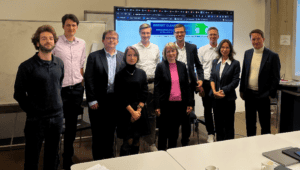
Credits: MINDSET_Clean_H₂ partners
Progress, results and applications (scientific, political, economic and social) of your project
5) After the launch of the projects in November 2024, what are the notable advances and results one year after the beginning of this adventure?
Svetlana Ikonnikova and Olivier Massol: In the first year, the consortium established a strong foundation for collaborative work, scientific exchange, and dissemination. Several key advances include:
- The development of baseline models for hydrogen demand estimation, integrating carbon pricing, energy costs, and sectoral adoption (TUM);
- A comprehensive study of the water needs for hydrogen electrolysis in Germany, identifying regional water stress factors and infrastructure implications (DIW Berlin);
- Economic modeling of clean hydrogen markets, including CO₂ cost pass-through, imperfect competition, and bilateral oligopoly frameworks drawing parallels with the LNG trade (TUM & DIW);
- A qualitative and quantitative assessment of sustainable aviation fuels (SAFs) and their dependency on hydrogen-based e-fuels, analyzing biases and effectiveness of decarbonization pathways (CentraleSupélec); and
- Organization of joint academic and stakeholder workshops in Paris (June 2025) and Munich (Octobe, 2025), fostering dialogue between researchers, industry, and policymakers.
All the activities aim and demonstrate the project’s capacity to connect modeling innovations with real-world policy relevance.
6) What are the next big steps in the development of your project and how you plan:
- By the end of the project, in two years?
Svetlana Ikonnikova and Olivier Massol:
- Integration of the three national models (TUM’s trade model, DIW’s HydrOGEnMod, and CS’s institutional modeling) into a joint open-source platform for hydrogen trade simulation.
- Publication of several scientific papers on hydrogen market, low-carbon fuels, and infrastructure development.
- Delivery of policy briefs and practitioners-oriented info-session on contract structuring, hydrogen transport planning, and demand coordination.
- Organization of research exchanges and workshops for young researchers on energy modeling and hydrogen economics.
- After the project, in 5 years?
Svetlana Ikonnikova and Olivier Massol:
- Expansion of the MINDSET framework into a global hydrogen trade observatory, continuously updated with real-world data.
- Collaboration with industrial and policy partners to apply the models to investment and policy planning for hydrogen corridors.
- Contribution to academic curricula and Franco-German innovation programs fostering sustainable energy market education.
Crossing Borders: Opportunities and Benefits
7) What are the assets and advantages of working in cooperation with Germany/France on your project?
Svetlana Ikonnikova and Olivier Massol: Franco-German cooperation brings together complementary perspectives and capabilities:
- The French expertise in system design, regulation, and industrial engineering;
- The German strength in quantitative modeling, infrastructure economics, and energy policy analysis.
This combination enhances the analytical scope of the project, broadens access to high-quality data, and enriches model calibration with diverse real-world cases. Working as a binational team (with multinational collaborations) fosters creativity, strengthens cross-border understanding of market instruments, and promotes shared solutions for the European hydrogen transition.
8) Do you notice any differences or peculiarities in this Franco-German bilateral work?
Svetlana Ikonnikova and Olivier Massol: The collaboration benefits from the partners’ shared academic background in natural gas and power markets, which provides a strong foundation for modeling hydrogen trade. However, methodological traditions differ: the French approach emphasizes institutional and regulatory frameworks, while the German approach focuses on data-intensive modeling and equilibrium analysis. This diversity enhances the robustness of the joint research and stimulates new interdisciplinary methodologies.
Furthermore, the project has also provided a unique opportunity to develop a shared understanding of hydrogen’s role in the energy transition. The initial seminar helped identify and articulate differences in national perspectives regarding the strategic importance and future deployment of hydrogen. As the collaboration has progressed, the teams have made steady advances toward a more integrated and mutually informed vision, fostering convergence in both analytical frameworks and policy interpretations.
The contribution of research, challenges and obstacles
9) In your opinion, what road does Europe still have to travel in terms of innovation and technology transfer to achieve its ambitions by 2030/2040 on hydrogen issues, and more broadly on decarbonized energy? In particular, what role does the transfer of research to industry and society play in achieving national, European and international decarbonization objectives?
Svetlana Ikonnikova and Olivier Massol: Europe must accelerate the transfer of research into scalable industrial solutions, particularly for non-fossil derived hydrogen technologies (electrolysis), hydrogen transport infrastructure, and market integration mechanisms. Ensuring compatibility and complementarity between national hydrogen policies will be essential to avoid fragmented markets.
Bridging the gap between academia and industry requires sustained political and financial support for pilot projects and regulatory experimentation. The MINDSET_Clean_H₂ project contributes to this by providing decision-support tools and transparent modeling frameworks that can guide both policy design and corporate strategy, ensuring that innovation aligns with Europe’s decarbonization targets.
Beyond the academic dimension, this collaborative process has also deepened the partners’ understanding of industrial positioning on both sides of the Rhine, thereby laying the groundwork for future research that is more attuned to the realities of each national ecosystem. Regular workshops, which bring together academic teams and industrial stakeholders, further reinforce this mutual understanding by fostering dialogue on technical, economic, and policy challenges. These meetings also help to better map the current state of European hydrogen technologies and to design more adaptive regulatory frameworks — ones that enable EU players to innovate and scale up more rapidly.
In addition, the project’s open and outward-looking approach, with constant attention to developments in other regions of the world, provides significant added value for industrial stakeholders in both countries. By pooling academic interactions with peer teams in key hydrogen-producing countries such as Morocco and Chile, as well as in major importing economies like Japan, the partnership enables participants to benchmark European strategies and business strengths within a truly global perspective. This comparative insight not only supports the design of more effective industrial and policy responses, but also creates new business opportunities and strategic partnerships. In doing so, the project further reinforces Franco-German leadership in international hydrogen cooperation.
10) According to you and your team, how does your project contribute to the construction of a decarbonized Europe?
Svetlana Ikonnikova and Olivier Massol: MINDSET_Clean_H₂ directly supports the creation of a resilient, competitive, and sustainable hydrogen economy in Europe by:
- Developing and presenting open-access analytical tools for hydrogen off-take and the need for market coordination have inspired industry dialogs, especially in the topic of energy price expectations and coordination of investments in transport infrastructure (e.g., with World Bank and SWM);
- Informing policy discussions pointing to the questions of fossil-based capacity retirement incentives and cost-sharing mechanisms;
- Educating a new generation of researchers, several MS students, in the economics of clean hydrogen.
- Building bridges between academia and industry, fostering structured exchanges that accelerate the translation of research insights into actionable business strategies and innovative policy design, while also helping European academic research to identify the most relevant topics to support stakeholders in accelerating the energy transition.
Together, these contributions strengthen the scientific and policy foundation for Europe’s transition toward net-zero emissions.
To go further, some publications:
- The international trade model HydrOGEnMod that is further expanded and enriched with stochastic scenarios at DIW Berlin can be found in Lukas Barner (2024): A multi-commodity partial equilibrium model of imperfect competition in future global hydrogen markets. Energy, Vol. 311, pp. 133284. https://doi.org/10.1016/j.energy.2024.133284 (open access)
- The analysis of future hydrogen demand in the aviation sector (particularly through Sustainable Aviation Fuels (SAF)) has led to two publications:
- Bardon, P., Massol, O., Thomas, A., 2025. “Greening Aviation with Sustainable Aviation Fuels: Insights from decarbonization scenarios,” Journal of Environmental Management, 374, 123943. https://doi.org/10.1016/j.jenvman.2024.123943 (open access)
- Bardon, P., Massol, O., 2025. “Decarbonizing aviation with sustainable aviation fuels: Myths and realities of the roadmaps to net zero by 2050,” Renewable and Sustainable Energy Reviews, 211. 115279. https://doi.org/10.1016/j.rser.2024.115279 (open access)
The Office for Science and Technology extends its warmest thanks to Prof. Svetlana Ikonnikova (TUM) and Prof. Olivier Massol (CentraleSupélec) for their participation
Réalisation du portrait : Loïs VAUGEOIS. Relecture : Siegfried MARTIN-DIAZ, Victor COULON. Mai 2026