
Within the joint call “Development of the hydrogen pathway for the future energy mix”, the German Federal Ministry of Research, Technology and Space (BMFTR) and the French Ministry of Higher Education, Research and Space (MESRE) via the French National Research Agency (ANR) are funding five innovative projects that provide solutions to key challenges in the development of a hydrogen economy. One of these projects is IDEAS (Innovative Degradation Analysis and Material Development for AEM Systems), whose German and French coordinators, Lukas Mues and Dr.-Eng. Christian Beauger respectively, told us more about the aim of this project. Enjoy the read!
The research environment
1) Can you introduce yourself as a researcher?
Christian Beauger: My name is Christian Beauger, I am professor at MINES Paris – PSL (University of Paris Sciences and Letters) but also research director and head of MATPRO (Materials and Processes for Energy) group, working in PERSEE research Center located at Sophia Antipolis, France. I have been working on hydrogen-energy related topics for 25 years, first for 5 years in a private research Center, IMRA Europe, affiliated to AISIN Seiki, then at MINES Paris – PSL. I am mainly involved in materials development, catalysts and membranes, Membrane Electrode Assemblies (MEAs) for Proton exchange membrane fuel cell (PEMFC), Polymer electrolyte membrane electrolysis (PEMWE) and now Anion Exchange Membrane Water Electrolysis (AEMWE), from their synthesis and characterization to their performance assessment in single cell. I graduated from Chemistry Engineering School of Montpellier (ENSCM) and got a PhD from School of Mines of Saint-Etienne (ENSMSE). I have been coordinating several national research projects in the domain of PEMFC and PEMWE (ANR, PEPR) and was principal investigator (PI) in several European research projects (FP7, H2020).
2) In what scientific environment do you evolve?
Christian Beauger: PERSEE research Center is one of the 18 research Centers of MINES Paris – PSL, a top-3 French Engineering School, the 1st one for its contractual activity. The MATPRO group of PERSEE develops a research activity on materials and processes (synthesis, characterization and modelling) for energy, mainly focused on hydrogen-energy (fuel cell and electrolysis, photocatalysis) with additional activities on batteries and thermal superinsulation. Located on the Sophia Antipolis technopole we can benefit from the research infrastructure of different research labs from MINES Paris – PSL mainly as well as Nice-Côte d’Azur University (UCA). The group has on its own four materials labs for the synthesis and characterization of a unique class of materials, aerogels, and one H2 lab for single cell and stack characterization (from 5 cm² to 10 kW). With years we have been developing a wide network of collaborations, nationally and internationally, with academic and industrial partners.
Presentation of the project
3) Can you present us your scientific project in the field of hydrogen?
Christian Beauger and Lukas Mues: IDEAS project aims to improve the efficiency, durability and understanding of degradation processes in anion exchange membrane water electrolysis at the single-cell level.
It combines materials development, electrochemical testing, advanced diagnostics, modelling and data analysis. A key focus is the optimization of catalyst layers and MEAs, including novel materials such as aerogel-based catalysts. These are evaluated from half-cell to single-cell measurements, with emphasis on identifying degradation pathways under realistic operating conditions.
Modelling and Artificial Intelligence (AI) tools are developed to link experimental results to degradation mechanisms and to build a structured database for predictive analysis. The project establishes methods and models that could later support future scale-up activities, but its work remains at material and single-cell level.
4) Can you present us the team behind the project (PIs, PhD students, post docs etc.)?
Christian Beauger and Lukas Mues:
Partners from MINES Paris-PSL/PERSEE (France):
- Dr.-Eng. Christian BEAUGER: Professor & Group leader Materials and Processes for energy (MATPRO). French coordinator of the project and PhD supervisor.
- Dr.-Eng. Alain JACOB: Research Engineer. PhD co-supervisor, works on electrochemical techniques development and operation (RDE, Single-cell test bench)
- Dr.-Eng. Pedro AFFONSO NOBREGA: Assistant Professor. Post doc supervisor, works on development of 0D model for AEM electrolysis
- Zaman YAZBECK: Post-doc. Works on development of 0D model for AEM electrolysis
- Cédric SERNISSI : Works on single-cell test bench development and maintenance
- Pierre ANTONCZAK: PhD student. Works on new catalysts development for AEM electrolysis (synthesis, characterization and electrochemical performance assessment).
Partners from Université Paris-Cité/ITODYS (France):
- Éric Brémond: Assistant Professor, Chemical Theory and Modeling (CTM). Works on Development of a Machine Learning (ML) model for membrane degradation
- Hyacinthe Randriamahazaka: Full Professor, BIOelectronics Smart Surfaces, Energy (BIOSSE). Works on development of model for the Physical Informed Neural
Network Catalyzer and data analysis - Upcoming PhD on machine learning
- Upcoming PhD on electrochemistry and data analysis
- Upcoming master students
Partners from DLR (Germany):
- Lukas Mues: Research scientist at DLR Oldenburg, German coordinator of the project and responsible for electrode coatings, MEA electrochemical and ex-situ testing.
- Corinna Harms: Group Leader Alkaline Membrane Electrochemistry (AME) at DLR Oldenburg. Supports concept development and validation of results.
- Aldo Gago: Group Leader Low Temperature Polymer Electrolyte Membrane Fuel Cells & Electrolysis (LTPEM) at DLR Stuttgart. Supports concept development and validation of results.
- Daniel García-Sánchez: Senior Researcher at DLR Stuttgart, responsible for the segmented cell for fuel cells and electrolysis. Main researcher in charge of the IDEAS project at DLR Stuttgart. Responsible for concept development of the AEMWE segmented cell and contributes to the development of testing protocols for IDEAS project materials.
- Benjamin Kimmel: Research scientist and PhD student at DLR Stuttgart. Collaborates with Dr. García-Sánchez on the development of the AEMWE segmented cell. Responsible for performing tests on IDEAS materials and managing test facility setups and test benches for AEMWE within the IDEAS project.
- Olivier Garrot: Technician at DLR at DLR Stuttgart. Develops the SC software for visualization of current density and temperature distributions.
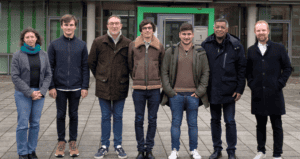 Credits: IDEAS partners
Progress, results and applications (scientific, political, economic and social) of your project
5) After the launch of the projects in November 2024, what are the notable advances and results one year after the beginning of this adventure?
Christian Beauger and Lukas Mues: Since the start of the IDEAS project in November 2024, key progress has been made:
- First aerogel-based catalysts were synthesized and characterized.
- Common test protocols for single-cell AEMWE measurements were established.
- A prototype of a segmented AEMWE cell was designed and built to measure local current and temperature distribution; validation is the next step.
- Development of a numerical model for AEMWE has begun to support understanding of degradation and to generate synthetic data for AI-based degradation prediction.
These achievements provide a solid basis for the next phase, including long-term single-cell testing and refinement of materials, diagnostics and models.
6) What are the next big steps in the development of your project and how you plan:
- By the end of the project, in two years?
Christian Beauger and Lukas Mues: The next steps include optimizing materials and MEAs, performing single-cell degradation measurements varying operational parameters followed by ex-situ methods to gain information about degradation phenomena, and using the segmented cell to investigate local degradation effects. The experimental data will feed into the shared database and modelling tools. By the end of the project, we aim to demonstrate improved stability at single-cell level and provide validated degradation models and diagnostic methods.
- After the project, in 5 years?
Christian Beauger and Lukas Mues: Beyond the project, the most promising materials, MEA designs and diagnostic approaches could be further developed and transferred towards higher Technology readiness level (TRL) and stack-level testing in follow-up projects. The modelling and AI tools could evolve into predictive tools for degradation and lifetime assessment. This would be the next logical step, but lies beyond the current project scope
Crossing Borders: Opportunities and Benefits
7) What are the assets and advantages of working in cooperation with Germany/France on your project?
Christian Beauger and Lukas Mues: The Franco-German collaboration benefits from complementary strengths: German partners focus on MEA development and electrochemical characterization, while French partners contribute modelling, data analysis and materials synthesis and characterization. Shared protocols and infrastructure allow comparable single-cell results and strengthen the European research landscape.
8) Do you notice any differences or peculiarities in this Franco-German bilateral work?
Christian Beauger and Lukas Mues: Differences in this collaboration arise mainly from institutional and administrative frameworks, such as funding and reporting procedures. These require coordination but do not hinder the scientific work. Joint objectives and complementary expertise make the collaboration productive and enriching
The contribution of research, challenges and obstacles
9) In your opinion, what road does Europe still have to travel in terms of innovation and technology transfer to achieve its ambitions by 2030/2040 on hydrogen issues, and more broadly on decarbonized energy? In particular, what role does the transfer of research to industry and society play in achieving national, European and international decarbonization objectives?
Christian Beauger and Lukas Mues: Europe has strong research in hydrogen technologies, but achieving 2030/2040 goals depends on how effectively laboratory results are transferred into practical and industrial use. This requires reliable long-term data, standardized methods and coordinated support along the entire hydrogen value chain, not only production. Research transfer into industry and society is therefore crucial to building a decarbonized energy system.
10) According to you and your team, how does your project contribute to the construction of a decarbonized Europe?
Christian Beauger and Lukas Mues: Our project contributes by improving the scientific basis of AEM water electrolysis. In 2025, we help reduce barriers to wider use by developing more stable MEAs and catalyst layers, harmonizing single-cell testing methods and improving the understanding and prediction of degradation through modelling and AI. This supports Europe’s climate goals by strengthening efficient, durable hydrogen production technologies at the cell level.
The Office for Science and Technology extends its warmest thanks to Lukas Mues (DLR) and Dr.-Eng. Christian Beauger (Mines Paris – PSL).
Réalisation du portrait : Loïs VAUGEOIS. Relecture : Siegfried MARTIN-DIAZ, Victor COULON. Mai 2026