
Within the joint call “Development of the hydrogen pathway for the future energy mix”, the German Federal Ministry of Research, Technology and Space (BMFTR) and the French Ministry of Higher Education, Research and Space (MESRE) via the French National Research Agency (ANR) are funding five innovative projects that provide solutions to key challenges in the development of a hydrogen economy. One of these projects is HADES (Hydrogen through Ammonia Decomposition for Energy Storage), whose German and French coordinators, Dr. Julian Dailly and Dr. Pascal Briois respectively, told us more about the aim of this project. Enjoy the read!
The research environment
1) Can you introduce yourself as a researcher?
Julian Dailly: I am Dr. Julian Dailly, working at the European Institute for Energy Research (EIFER) since more than 15 years now. I have about 20 years of experience on fuel cells and hydrogen activities, with a background (Engineer diploma, Master and PhD) on solid state chemistry and electrochemistry. At EIFER, I am projects coordinator for hydrogen and E-fuels topics and head of the ENERMAT Laboratory, dedicated to the synthesis and characterization of materials and electrochemical cells for energy-based applications. Next to HADES, I also have the coordination of the European project POSEIDON dedicated to the demonstration of e-methanol for maritime applications. I also give a lecture at the Institute for Chemical Technology and Polymer Chemistry – KIT on Hydrogen, Fuel Cells and E-Fuels and I am the president of the International Society for Protonic Ceramic Conductors ISPC² and Chairman of the International Conference Prospects on Protonic Ceramic Cells PPCC.
I am used to work in Franco-German environment, as HADES is the continuity of long-term collaborations with the German Aerospace Center (DLR) and Karlsruhe Institute of Technology (KIT) in Germany, National Center for Scientific Research (CNRS) and Electricity of France (EDF) in France in the frame of several national, binational or international activities. In particular, EIFER, DLR and CNRS already collaborated during the ARCADE project (2019-2023), coordinated by DLR and funded by the Federal Ministry of Education and Research (BMBF) and French National Research Agency (ANR) in the frame of the French-German joint call on sustainable Energy.
2) In what scientific environment do you evolve?
Julian Dailly: I am working at the European Institute for Energy Research, which was created in 2002 between EDF in France and KIT in Germany. EIFER is an independent French-German research institute bridging the gap between science and industry. With more than 20 different nationalities, EIFER is a stimulating multi-cultural environment, promoting local anchorage, diversity and excellence. For over 20 years, EIFER has contributed to the development of cost-effective, high-performance and sustainable hydrogen solutions, supporting the advancement of hydrogen technologies along the whole value chain, from laboratory research level to market and business case studies. In the last 10 years, we have included carbon- and nitrogen-based synthetic renewable products (like e-fuels) in our scope of activities.
Credits: HADES partners
Presentation of the project
3) Can you present us your scientific project in the field of hydrogen?
Julian Dailly and Pascal Briois: The HADES partners commit themselves to pave the way for the future market uptake of green H2 from NH3 decomposition by developing an efficient and cost-effective CO2 free technology based on a planar reactor. HADES aims to enable the one-step electrocatalytic NH3 cracking, H2 compression/purification from renewables through an electrochemical protonic ceramic reactor. Hades will promote the process-intensification advantages combining electrochemical membrane reactors and advanced catalysis to set-up a highly efficient, compact, and modular technology. The first objective is to decipher the NH3 decomposition mechanisms to select the appropriate cell materials. To build the reactor, metal-supported and cermet-supported protonic ceramic cells (MS-PCC and CS-PCC) will be compared to reduce the capital expenses of the technology. The cells manufacture will be supported by modelling activities to optimize the microstructure, but also to target specific operation conditions to lower the operational expenditures. It will also provide recommendations for process integration and application cases. Based on economics, environmental, social, regulatory and safety studies, HADES will identify the market needs for H2 from NH3 cracking, provide recommendations to policymakers, and highlight its benefits compared to other technologies.
To summarize, the technology proposed in HADES is indeed a cost effective and fully scalable reactor able to produce and compress pure H2 for various applications. Thanks to its scalability and the already industrial compatibility of NH3 for transport and storage, it brings a delocalization potential to supply H2 where no distribution infrastructure exists.
4) Can you present us the team behind the project (PIs, PhD students, post docs etc.)?
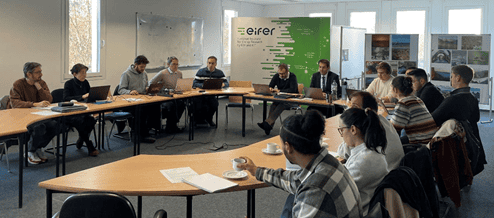
Julian Dailly and Pascal Briois: The project consortium has been constructed to bring together partners with the required knowledge to fulfil all the relevant tasks and maximizes the outcomes of the project. It consists of partners in both academia – CNRS with 4 sub-entities: FEMTO, Charles Gerhardt Institute Montpellier (ICGM), Nantes Materials Institute (IMN) and Institute of Chemistry of Environments and Materials in Poitiers (IC2MP) (France), EIFER, DLR and KIT-ITCP (Germany) –, and industry – EDF (France).
- EIFER (Coordinator, DE): Dr. Julian Dailly (project coordinator, head of a research laboratory), Dr. Ing. Till M. Bachmann (project manager and senior researcher) and Dipl. -Sociologist M. Leucht (project manager and senior researcher).
- DLR (DE): Dr. Rémi Costa (Group leader High Temperature Cells and Stacks).
- KIT-ITCP (DE): Prof. Dr. Olaf Deutschmann (Full Professor, chair for chemical technology).
- CNRS-FEMTO (Co-coordinator, FR): Dr Pascal Briois (Head of the MN2S department and Associate professor).
- CNRS-ICGM (FR): Prof. Gilles Taillades (Professor).
- CNRS-IMN (FR): Dr. Clément Nicollet (Researcher).
- CNRS-IC2MP (FR): Dr. Clément Comminges (Associate Professor) and Dr. Nicolas Bion (Research Director).
- EDF (FR): Dr. Michael Fernandez (Researcher).
- Finally, 4 young researchers will be educated during the project through joint PhD thesis between the partners.
Progress, results and applications (scientific, political, economic and social) of your project
5) After the launch of the projects in November 2024, what are the notable advances and results one year after the beginning of this adventure?
Julian Dailly and Pascal Briois: The first year of the project was focused on the implementation of our research strategy for the different activities. It included the recruitment of the PhD students, the start of the development of materials and manufacture of cells within our WP1 and WP2 and the associated structural and microstructural characterizations. Various configurations of cells are being manufactured, and the future electrochemical measurements will help to determine the best performing materials and configurations. The mechanistic investigation in WP4 also started with great interaction between the partners for the preparation and characterization of the samples. First NH3-cracking performances were measured on various kinds of materials to gather information on the NH3-cracking mechanisms. Furthermore, first exchanges have been made to define hypothesis and identify the main parameters for techno-economic analysis, life cycle assessment and the social acceptance in WP5. It is of great importance to define the correct boundaries of our system as it will trigger its comparison with already existing technologies. Finally, the establishment of our communication toolbox (webpage, logo, templates, etc.) is still on-going.
6) What are the next big steps in the development of your project and how you plan:
- By the end of the project, in two years?
Julian Dailly and Pascal Briois: The main achievement to be completed by the end of the project will be the development of 5 cm² cells based on industrial processes and including innovative catalysts. The modeling activities will enable the upgrade of the cells and the definition of fine-tuned operation conditions. It implies robust performances and increased durability to reach a TRL of 4. The project outcomes will also be used to create an outlook on the economic, environmental, social and industrial viability of HADES and identify remaining challenges (if any) including future work necessary for further development.
- After the project, in 5 years?
Julian Dailly and Pascal Briois: Our project is based on a middle-term development strategy from 2025 to 2040 with three main steps: development of cells (HADES, 2025-2028), up-scaling and stack integration (2028-2030) and modules manufacture (2030-2035). These steps will be mainly developed through public funded activities and industrial collaboration to reach the final commercialization preparation (2035-2040).

Credits: HADES partners
Crossing Borders: Opportunities and Benefits
7) What are the assets and advantages of working in cooperation with Germany/France on your project?
Julian Dailly and Pascal Briois: The novelty of this DE-FR collaboration is that HADES cover the entire knowledge and innovation chain including fundamental and applied research (CNRS, FR / KIT, DE), practical/applied (EIFER, DLR, DE) and industrial research (EDF, FR + AB: Hynamics, FR / DE). The joint knowledge, experience and application interest amongst the partners can help drive the development of the HADES technology and the collaboration between the partners will continue beyond the current project, which aligns with the long-term EU policy of technological leadership in the field of H2 energy and energetic transition. EIFER, DLR, CNRS are active members of H2 Europe Research. Active participation and representation in the different technical committees will ensure incorporation of the outcomes of the project in the different roadmaps for the development of H2 technology at the EU level.
8) Do you notice any differences or peculiarities in this Franco-German bilateral work?
Julian Dailly and Pascal Briois: The consortium benefits from existing long-term transnational collaborations. The added value in this FR-DE cooperation derives from the complementary interest on both side (service providers EDF + Hynamics FR and Hynamics DE in the AB) with CNRS, EIFER, DLR and KIT facilitating the bridge-building. The FR-DE cooperation is the unique chance to merge the complementary expertise in each country to address the challenge of developing PCCs with cost effective manufacturing routes, which can lead to innovative breakthrough and a technological leadership worldwide.
The contribution of research, challenges and obstacles
9) In your opinion, what road does Europe still have to travel in terms of innovation and technology transfer to achieve its ambitions by 2030/2040 on hydrogen issues, and more broadly on decarbonized energy? In particular, what role does the transfer of research to industry and society play in achieving national, European and international decarbonization objectives?
Julian Dailly and Pascal Briois: The future important role of H2 technologies is already obvious in worldwide energy roadmaps and in FR / DE national strategies. The energy transition from fossil fuels towards renewables requires indeed a quick development of water electrolysis to produce low carbon H2 for cross-sectoral industries like steel and chemistry, production of e-fuels (e-kerosene, e-methanol, etc.) and even support the supply of H2 grids. Unfortunately, their speed of development and deployment remains an uncertainty factor. One of the reasons is the huge, targeted amount of H2 to cover the future energy needs, which highlights the shortage of H2 production potential in Europe, and the challenges associated to H2 storage and transport, which hinder its importation from outside of Europe. Thus, importation of energy should be considered by using convenient vectors like NH3. While many alternative molecules remain at the pre-commercial stage of development, there is already a worldwide infrastructure for the transport and storage of NH3, as the molecule is used as to synthetize fertilizers in the agricultural sector. NH3 is the second most widely produced chemical and already appears as the most promising compounds for chemical storage of energy and H2. By counterbalancing the storage and transport drawbacks of the H2 molecule, NH3 can enhance the H2 economy in Europe. One of the main challenges that needs to be overcome is the development of new NH3-cracking technologies that allow green H2 to be recovered at low price. Current NH3-cracking processes are energy consuming and need additional purification steps to reach the required H2 quality for its final use. There is a need for developing an efficient technology that can decompose NH3 efficiently and produce pure and compressed H2 for a direct use in cross-sectoral applications.
10) According to you and your team, how does your project contribute to the construction of a decarbonized Europe?
Julian Dailly and Pascal Briois: The main outcome of the HADES project will be a reactor validated at lab-scale for the implementation of renewable compressed H2 from NH3-cracking. By providing this additional H2 supply chain, the HADES technology can accelerate the deployment of the H2 economy in Europe. Taking advantage of existing Solid Oxide Electrolyzer Cells progress, a ten-year development step is enough to climb the TRL levels to reach market entrance, and small systems (1 MW) would be available by 2040. Thus, it will offer an avenue for the supply and development of H2-consuming technologies (e-fuels production) and industries (steel, chemistry), as well as grid stabilization due to inherent fluctuations in renewable energy sources, recommendation of operating conditions and implementation characteristics for industrial users, plus an increase of social acceptance of Power-to-X technologies (PtX). HADES will provide guidance of improvement potentials to identified social impacts and follow-up inter-/trans-disciplinary research projects to accelerate market deployment of the technology. NH3 is already industrial and benefits from an already existing regulatory framework, which currently enhances the deployment of NH3 as fuel for applications like shipping. Whereas NH3 is toxic and harmful to the environment, the European Maritime Safety Agency concluded that the challenges related to health, safety and environment can be managed. The development of standards, already on-going (e.g. by DVGW German Gas and Water Association), will be reinforced by the work performed in HADES on the safety and regulations aspects for the cross-sectional use of H2 from NH3.
The Office for Science and Technology extends its warmest thanks to Dr. Julian Dailly, from the European Institute for Energy Research and Dr. Pascal Briois, from the University of Technology Belfort-Montbéliard (FEMTO-ST).
Réalisation du portrait : Loïs VAUGEOIS. Relecture : Siegfried MARTIN-DIAZ, Victor COULON. Avril 2026