
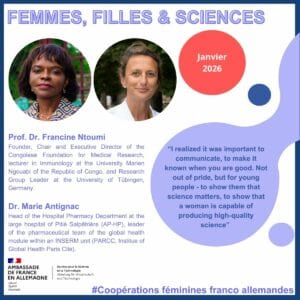
Le Service pour la science et la technologie de l’Ambassade de France en Allemagne met en lumière des femmes scientifiques et des managers de projets, en particulier des coopérations franco-allemandes scientifiques féminines, contribuant ainsi à la déclinaison par l’Ambassade de France en Allemagne de la stratégie internationale de la France pour une diplomatie féministe (2025-2030). Plus d’informations : https://de.ambafrance.org/Strategie-internationale-de-la-France-pour-une-diplomatie-feministe-2025-2030
Prof. Dr. Francine Ntoumi est fondatrice, présidente et directrice exécutive de la Fondation congolaise pour la recherche médicale (FCRM) en république du Congo, Professeure et responsable du groupe de recherche d’Epidémiologie des maladies infectieuses à l’institut de Médecine Tropicale de l’université de Tübingen, en Allemagne. Son principal domaine de recherche en tant que chercheuse en épidémiologie moléculaire des maladies infectieuses est le paludisme.
Dr Marie Antignac est responsable du service de pharmacie hospitalière des Hôpitaux de universitaires de la Pitié Salpêtrière et Ch FOIX (APHP). Affiliée à l’équipe d’épidémiologie 4 U 970 de l’Inserm, elle a conçu et dirige l’équipe pharmaceutique du module de santé mondiale au sein de l’unité INSERM, concentrant ses recherches depuis 2011 sur l’accès aux médicaments dans les pays à faible et moyen revenu. Ce travail est mené en étroite collaboration avec le Réseau Africain de Recherche.
Could you introduce yourselves?
Francine Ntoumi: My name is Francine Ntoumi, and I am from the Republic of Congo. I am a molecular epidemiologist specializing in infectious diseases. I completed my secondary school in Sceaux (France) and academic studies including my PhD in Paris VI (France) followed by a postdoctoral training at the Pasteur Institute in Paris, where I began working on infectious diseases. I would say it was quite a traditional academic path. After that, I learned to be a researcher on different continents: in France, Gabon, Germany, Tanzania and Republic of Congo. At one point in my career, I felt the desire to return to Rep of Congo and to pass on knowledge, particularly to encourage more women from the Central African subregion to pursue careers in science. I created and now lead the Fondation Congolaise pour la recherche médicale (Congolese Foundation for Medical Research, FCRM) to strengthen research capacity and local, regional and international collaborations because there was a critical gaps in trained human resources in medical research to address the local needs. So, I am both a manager and, of course, still a scientist, and I am heavily involved in advocacy. Today, I wear many hats while still trying to balance my family life.
Marie Antignac: My name is Marie Antignac. I am a trained pharmacist. I studied in Paris. During my studies, I realized that I wanted to do research. I passed the pharmacy residency exam and began working in the hospital as a pharmacy resident. For me, the hospital was truly a revelation, the teamwork in a hospital setting, I found it wonderful. I told myself, this is what you want to do. I completed my four-year residency, and during those four years, I took a one-year break to complete a DEA, what is now called a Master’s degree. Then I finished my residency, and during my assistantship, I completed a PhD in pharmacology and HDR (University research habilitation) in epidemiology. I wanted to have both: research and hospital work, which I managed to do, although I left pure pharmacology and moved into epidemiological research [the study of the distribution of diseases and their determinants within human populations, ndlr]. In hospitals, pharmacy is a support service. We are what people call “the invisible ones”; patients assume that medicines and surgical supplies just appear out of nowhere. We manage the entire medication circuit, health products, sterile medical devices, but also production units, chemotherapy preparation, sterilization of surgical devices, radiopharmacy units, etc. People often ask if I work with anyone else. Yes, I work with 206 colleagues in our pharmacy at the Pitié-Salpêtrière Hospital (APHP)… We have six functional units, we manage €85 million worth of medical devices and €150 million worth of medicines, and we operate 24/7, we never stop. If I go down on one knee, the hospital goes down on one knee. All support services are essential to the functioning of the system. During my career, I was fortunate to meet Xavier Jouven [a French cardiologist, epistemologist, and global health expert, ndlr] which allowed me to combine a third area that interested me greatly: Africa. Together, we gradually built the African Research Network for Non-communicable Diseases. He already had contacts with African cardiologists. Little by little, we brought in diabetologists and pharmacists. We now have a network across 20 countries and have carried out several studies, including the one I briefly mentioned at the World Health Summit in Berlin, on medicine quality. So today, I am fortunate to hold both the position of head of the hospital pharmacy at Pitié-Salpêtrière in Paris and to conduct research as an Institut national de la santé et de la recherche médicale (National Institute of Health and Medical Research, Inserm) affiliate on the epidemiology of noncommunicable diseases in sub-Saharan Africa.
Could you tell us about your research?
Francine Ntoumi: I began my “professional” research activities at the Pasteur Institute working on malaria. It is a disease that is still one of the public health priorities on the African continent. Since I am a molecular epidemiologist and, throughout my career, North–South and south-south collaborations have been constant, I worked extensively on malaria parasites [which transmit the disease, ndlr] collected in Senegal. Then I went to Gabon, where I worked with field isolates collected from Gabonese and Cameroonian individuals (children and adults/asymptomatic and symptomatic). I began studying malaria resistance to antimalarial drugs using molecular tools. I therefore became interested, for example, in the sickle cell trait, a red blood cell disease found particularly in sub-Saharan or Afro-descendant populations. People who have this disease are very vulnerable to malaria, but those who are heterozygous [said of an individual whose alleles – genes with the same function, located at the same position and carried on the chromosomes of the same pair – are different, ndlr] are more “resistant” to severe malaria. So, I used it as a model to try to better understand the immune mechanisms of those affected infected people comparing parasites genotypes and humoral and cellular immune responses. Infectious diseases are not limited to malaria. When I returned to Congo, I set up various research teams that worked on these other diseases. I became interested in tuberculosis, HIV/AIDS, Mpox, and chikungunya, for which we have recurrent epidemics. We worked extensively with colleagues on the Covid-19 pandemic, and especially with the local and continental authorities (WHO/AFRO and Africa CDC), to understand this disease in our context. Currently, I am very involved in One Health topics [an integrated, global, and multisectoral approach that highlights the relationships between human health, animal/plant health, and ecosystems, ndlr]. Already in malaria research, you cannot understand the disease by looking only at molecular epidemiology. So, my results were of course always examined together with those of others. But with the One Health approach, researchers are encouraged to collaborate more broadly including multisdisciplinarity ad various sectors. In Rep of Congo, my field of investigation has expanded, as has the field of collaboration, particularly with the Democratic Republic of Congo, where there are many issues – it is a much larger country with huge population compared to the republic of Congo. Environmental issues had been very neglected, as had animal research, because in Rep of Congo there are very few veterinary researchers. These are the subjects we work on: animal research, environmental research, human health of course, and all these different diseases. It is exciting because the angle is now bigger! And of course North-South collaboration remains constant. All the research activities we conduct are collaborative, with France, England, Italy, and Germany. With Germany, the collaboration is particularly strong because I am also affiliated with the University of Tübingen and the director of the institute of Tropical Medicine/university of Tübingen is also the vice-president of FCRM.
Marie Antignac: I am affiliated with an Inserm team on Integrative Epidemiology of cardiovascular diseases, and we work with an African network, the African Research Network for Chronic Diseases. The foundation of this relationship is that the topics, ideas, and research questions come from our African colleagues. We try not to say: we have a research question and we will look over there to see what is happening; it is really the opposite. We make ourselves available, and we provide our tools, epidemiological expertise, analysis know-how, data collection, analysis, etc. That is actually how we began working on medicine quality. As a French pharmacist in a large French hospital, the issue of medicine quality was not on my radar. Within the Inserm team, we have several research themes, including a Global Health module. And within this module, I lead the pharmaceutical group that works with our African colleagues to identify problems, relate them to the existing scientific literature, and design studies to try to answer these questions and produce robust data. In sub-Saharan Africa, we observed a lack of robust, multinational data; data were often disparate, punctual, coming from a single center. There is a lot of expertise, but not much cooperation between countries. So, this pharmaceutical group supports study design and data collection. We coordinate this African Research Network of 20 countries and host students so they can work on research topics, whether for Master’s degrees or PhDs. We build collaborations. At the beginning, I established collaborations with laboratories to conduct medicine quality control. Now, funding is starting to appear in global health, but fifteen years ago, there was none. You know, Europeans tend to believe that the African population dies of infectious diseases and hunger. All other topics are ignored. One such topic is access to medicines. There are five dimensions to access to medicines. Is the medicine available in the country? Is it available in the region where the patient lives? Can the patient afford it? These three dimensions are fairly well explored in the literature. And the last two dimensions are the ones that particularly interested us: acceptability – meaning whether the physician prescribes the treatment properly and whether the patient adheres to it – and finally, medicine quality, because there is no point in having a medicine that is available, accessible, and affordable if it is not of good quality. So we set up multinational studies on these last two dimensions. For example, we conducted a study on the medical management of hypertension in Africa among patients in twelve sub-Saharan African countries. Are they adherent to treatment? Is their hypertension controlled or not, and how is it controlled, and what therapeutic management is used? We found that regardless of their pharmacological treatment, if patients used traditional medicine specific to the African context, their hypertension was less well controlled than in those who did not. We also tried to identify the factors associated with polytherapy. In hypertension, you start with one medication; if it does not work, you add a second, then a third, and so on, there is an escalation. We found that this escalation of doses was not linked to the severity of the patient’s hypertension but to their place of residence: patients in rural environments very rarely received multitherapies. So we try to obtain high-quality data from many countries to provide robust information and help shape health policies.
Were gender/sex factors taken into account in your research?
Francine Ntoumi: That is a good and very interesting question because, over time, I must admit, I did not pay attention to gender in science for maybe more than ten or fifteen years. Then, while working on malaria, there is malaria during pregnancy which is a specific research field. So of course, in that case, we look at gender because malaria in pregnant women is a particular form of malaria, but that is specific. We participate in many clinical trials, and indeed, at the beginning, gender was not particularly taken into account in the enrollment of participants, for example. I would say that, over the years and today, gender and sex are taken into account in the research studies we conduct. We make sure to include both sexes in the studies as much as possible, because the data we collect can differ, immunologically, for example. And among investigators too, since women are a little less represented.
Marie Antignac: Among our studies, in our study on hypertensive patients, we realized something about African women that I had not anticipated: they actually had many more cardiovascular risk factors, for example they were heavier than men, more sedentary than men, whereas men had more complications. So that is really something very interesting. And following this line of thought, since September 2025, I have a PhD student who will carry out her work on the medical management of women in sub-Saharan Africa. That is her research topic, she will work on this, and she began using our databases. In particular, there is a recent database we have been building for the last ten years, an observatory of hospitalizations in sub-Saharan Africa. And from all this data, she will be able to explore whether women with risk factors receive different medical management compared to men or not.
How did gender impact your experience as a woman in your fields?
Marie Antignac: I work in Paris, so France is a major democratic country where, for a very long time, men and women are supposed to have the same rights. And I work in a profession, pharmacy, where even among people of my generation there have always been more women. So already at university, there were roughly 60-65% women; now I think it is even 70% or a bit more. But when I arrived at the hospital, all the heads of hospital pharmacy departments were men. That was something that really astonished me, I was naïve. And this situation takes an extremely long time to change.
Francine Ntoumi: In France, I was president of the scientific council of the Institut de recherche et de documentation en économie de la santé (Institute for Research and Documentation in Health Economics, IRDES) for several years, and indeed there are many female researchers, very good ones, but they do not apply for promotions. In Africa, the proportion of women in science – including medical sciences, where the proportion is the highest – is low. Of course, it varies by country: in South Africa, the proportion of girls in science is very high, but in Central Africa it is around 5% in Chad and 12% in Congo. We still have work to do. Personally, I did all my studies from high school through my postdoc in France, and then I began my scientific career in Europe, and to be honest, I was not aware that I was in a field where there were few women. I did not suffer from being a woman in science, nor from being a black woman in science. Perhaps it was linked to my environment, I don’t know. But after my postdoc, I came to Africa, and that is where I felt that I was a woman in science. Back in Congo, my voice was not heard. It is one thing to read about these issues in the literature, but experiencing them, you are never prepared. It is like racism: when you live it, it is something else entirely. In Congo, at first, I did not understand why I was not being listened to. I did not immediately realize that it was because I was a woman that I was ignored or discriminated against. And when I realized it, I was, of course, shaken. You wonder how to react to all this. My only answer was: you have to work; you have to work more and show these men what you are capable of as a woman. And to show what I was capable of, I took on yet another role: communication. It is very important because in France, you are taught to publish in the best journals, but after that, what do you do with it? You alone know you are a good researcher, but even your family doesn’t know. I realized it was important to communicate, to make it known when you are good. Not out of pride, but for young people – to show them that science matters, to show that a woman is capable of producing high-quality science in a hostile environment, because it really is a hostile environment. For example, I was published in the journal Science, one of the best scientific journals. When I had my first publication, I called the media and made it clear to them that no man in Congo had ever been published in this journal. It truly has an impact, to work hard and show young girls that you can be an African woman in this environment and that you have value, that you are capable. But throughout my career, I would say that being a black woman has always been more of an asset than a disadvantage. Very early on, I was invited to extremely high-level scientific meetings where, honestly, I know there were people better than me, but perhaps diversity was needed, and so I was the one invited. It allowed me to meet extremely brilliant people, including Nobel Prize winners. Being a black woman in science, and producing an enormous amount of high-quality work, opened doors for me.
Marie Antignac: Francine, you present the situation as if it was pure luck. I think no man would have presented it the way you just did: honestly, a man would have said, “I was there because I was the best,” that’s it. They invited you because you were at the right level, because you were the right person at that moment. When I did my work for the Medical Commission of the APHP, it was almost caricatural. I saw women with spectacular careers, who had published in major journals like the one you just mentioned, and who still questioned their own legitimacy. They wondered whether they would have time to take on a certain position, because if they accepted it, they wanted to do it well. A man looks at the title first, and only afterwards checks whether he has five minutes to squeeze it in. For women everywhere in the world, in the end, there are really common issues. And legitimacy is one point I have often noticed throughout my career. Personally, I did not have the feeling of being held back, prevented, or mistreated. But I also think I belong to a generation that didn’t see things. Some things seemed normal to us – for example, that the male resident beside us would be the one chosen to attend the conference. At the time, that didn’t shock me. But if I look back now, I can clearly see that my male colleagues of the same generation advanced more quickly; they became professors faster. Perhaps that played a role, but we cannot rewrite history; it is what it is. What I do try to do, however, because I am the mother of two daughters, is tell them that they can choose anything they want, that they can do anything they want, having been born in France at the time they were born, and that they must not accept being placed somewhere just because they are women.
Are you engaged for women in science?
Marie Antignac: I am quite involved in my daily work. I have invested a lot in structures within the APHP, where gender is now taken into account in career development so that women can access careers and positions of responsibility. We probably need to encourage this through quotas or other mechanisms so that more women become university professors. I had done the calculation: if we continue at the current pace of appointments with the same balance of men and women for professor positions, it would take us 37 years to reach 50% men and 50% women. Yet today, in the second year of medical school in France, 65% of students are women. For example, at APHP, we integrated into the annual evaluation document – which every medical supervisor must complete with their direct report – a question on gender. In particular: have you had difficulties because you are a woman? And also, to push the person conducting the interview to reflect: am I doing something inappropriate because the person in front of me is a man or a woman?
Francine Ntoumi: In Congo, I started the Women and Science program thinking that if we want things to change, we need to start raising awareness very early. With our campaign, over time, more and more parents encourage their daughters to study science. In the Women and Science program, we don’t focus only on biomedical sciences, it covers all disciplines. So, we run awareness campaigns in schools. We lack role models in Africa and in Central Africa, so we need to push these role models so that girls can envision themselves in these fields. Then we provide scholarships to female students at the master’s and PhD levels in Congo, thanks to support from the Bayard Foundation. We also have regional scholarships for the past two years across Central Africa, because Central Africa is the least dynamic region of the entire continent scientifically and economically, even though the land is very rich. So, we offer scholarships to PhD students from the Democratic Republic of Congo, Cameroon, Gabon, Chad, the Republic of Congo, and Equatorial Guinea. And we also have a scholarship category for postdocs who are mothers, to help these women balance family responsibilities with scientific commitments.
Do you see a new gender dialogue among the younger generation?
Marie Antignac: I find that the younger generation is more homogeneous between men and women. I think in my generation, men were more ambitious. Today, for both men and women, the relationship to work is no longer the same as it was for us. We worked more, worked later, that was what society expected. This younger generation places greater importance on life outside of work.
Francine Ntoumi: I completely agree with Marie when I look at European students, particularly German students, quality of life is much more important than anything else, for both girls and boys. I also see that girls do not let themselves be pushed aside: if they have decided to fight for a position, no one will take it from them. They are very ambitious and determined. But for African students, it is different; we are still in an older model, cultural expectations weigh heavily. Female students have to deal with an environment that tells them that life is not only about studies and they have to be mother as first goal, so we need to support them. Hence the importance of mentorship. They need encouragement, guidance. They question themselves a lot because they carry the weight of family expectations and age expectations: at 25 or 26, when they are doing a PhD, they are told they should already be married, should already have had their first child if they are a girl, otherwise their life is not what it “should” be. So, they must face this ongoing pressure, and they need a space to talk, to express their career aspirations, and perhaps how to reconcile them with family life. And in a laboratory, many male colleagues, when choosing between a male or female master’s or PhD student, will favor the male student. It is very clear. Because there is the “risk” that the female student becomes pregnant, something they do not find convenient. Regarding promotions, as in many countries, those who manage to secure research positions progress more slowly, not only because of maternity leave itself, but also because culturally, when a child is sick, it is not the man who stops working to take care of the child; it is the woman. But I created mentorship programs for boys as well, because they also need guidance. And when they join our institution (FCRM), which is led by a woman, it already helps them become more respectful toward women. I make it very clear that I see them – the boys: when they arrive, they try to impose their views on girls in meetings. They have this way of responding assertively, and the girl who actually has the legitimacy to reply no longer dares to speak; and if she does reply, some will burst out laughing. Very quickly, once I understood their way of functioning, I explained to everyone that everyone has the right to speak. I am extremely direct, which very quickly creates a climate of respect. I hate all forms of discrimination, including for example towards disabilities, to be taken into account so that everyone finds their place. Even if things are changing, I can see that it is improving, but we cannot let go yet. This support and guidance are still necessary.
Marie Antignac: This difference between Europe and Africa is very interesting. I feel that in Europe, the imbalance between men and women is more insidious. There is visible equality, but behind it, there are still many discriminations.
Do you see differences between France and Germany regarding women in science?
Francine Ntoumi: I would say that perhaps in France there is more support than in Germany. In Germany, there aren’t that many daycare centers, and as soon as you have a baby, it becomes difficult, you are almost forced to stop working. My son was born in France, and later we moved to Germany. When he was eight, he would take the metro alone to go home, whereas in France I would have found someone to look after him while I worked. Fortunately, the city of Stuttgart is very safe and everything has always gone very well.
What advice would you give to girls?
Marie Antignac: You must do what you truly want to do; you must not let yourself be discouraged or self-limit. From what I have observed in my teams, it is often women who limit themselves. But changing this is not easy.
Francine Ntoumi: I would like to pass on ambition, to pass on the idea – as the saying goes – that the sky is the only limit. But to push that limit further, you must learn, learn, and learn again. And then let your dreams unfold. In our African context, it is especially important to support girls and women because they are still so underrepresented and cultural barriers are still strong. We really need them to be much more present across all disciplines and encourage women leadership.
Entretien réalisé par Julie Le Gall, Noela Müller, Hugo Titeca, le 28 novembre 2025.
Rédaction : Noela Müller.
Mise à jour : le 28 janvier 2026.