
Le Service pour la science et la technologie de l’Ambassade de France en Allemagne met en lumière des femmes scientifiques et des managers de projets, en particulier des coopérations franco-allemandes scientifiques féminines, et contribue ainsi à la déclinaison par l’Ambassade de France en Allemagne de la stratégie internationale de la France pour une diplomatie féministe (2025-2030).
Plus d’informations : https://de.ambafrance.org/Strategie-internationale-de-la-France-pour-une-diplomatie-feministe-2025-2030
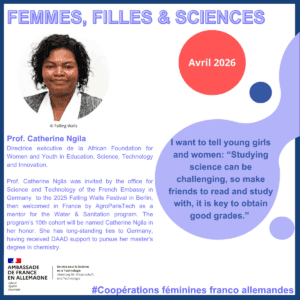
La Professeure Catherine Ngila est la Directrice exécutive de la African Foundation for Women and Youth in Education, Science, Technology and Innovation. Elle est professeure invitée en chimie analytique et environnementale à l’Université de Johannesburg. De plus, elle est membre du Groupe des 10 experts de l’ONU pour le mécanisme de facilitation technologique sur la science, la technologie et l’innovation (STI) pour les ODD. Elle est également vice-présidente de l’Organisation internationale des sciences chimiques pour le développement (IOCD).
Le Service pour la Science et la Technologie a souhaité, en 2025, encourager des coopérations trilatérales entre l’Allemagne, la France et un pays tiers d’Afrique dans le domaine de la recherche. Sur une idée de l’Ambassade de France au Kenya, Pr. Catherine Ngila a été l’invitée du Service pour la Science et la Technologie à l’Édition 2025 du Festival Falling Walls à Berlin, en novembre 2025. Après cela, Pr. Catherine Ngila a été l’invitée en France d’AgroParisTech en tant que mentor du programme Water & Sanitation. La 10ème classe de ce programme de master sera nommé Catherine Ngila en son honneur.
Can you introduce yourself and your research?
Catherine Ngila: My name is Jane Catherine Ngila. I was born in Kenya and grew up in Kenya. I did a Bachelor of Education in Science, majoring in chemistry and mathematics with a minor in education subjects. After that I went to teach in Kitui boys high school for one year. I then got a scholarship from the Deutscher Akademischer Austauschdienst (DAAD) to do a Master of Science in chemistry, because I had a first-class honors. During my master’s programme, I carried out my research in water. My project was about the aluminum from cooking pots and its impact on the water and soils.
When I submitted my master of science dissertation, I applied for a scholarship to go to Australia, under Australian International Assistance Bureau (AIDAB) equity and merit scholarship scheme (EMSS). I left Kenya and I went to the university of new South Wales in Australia in Sydney to do a PhD. After two years, I got married and had my first child, Charles. At that time, my husband was in Canada. He came to visit me, we got married and he said: “I will go back to Canada, and when I finish my Master’s degree in Veterinary Medicine then I come back to Australia to pursue doctorate degree in Veterinary science ”. However, he never came back because he a got a Job with World Health Organization as the coordinator of East and Central Africa project on Animal Food & Mouth disease with an office in Nairobi, Kenya. As a result, I was alone with a young baby in Sydney, away from home (Kenya). So, I was alone with a small baby, without the support of my husband while pursuing my doctoral degree at the University of New South Wales. Therefore, my doctoral degree supervisors, Prof Peter Alexander and Prof Brynn Hibbert, both male professors, were very supportive and helped request extension of my scholarship funding from 3years to 4 years. The funding extension application was made to the Australian government through the University of New South Wales (UNSW) scholarship office. As a result of the extension, I got extension of study period, covered by the scholarship. The scholarship covered tuition fee, living allowance, air ticket family dependants’ Air ticket and living expenses including health cover.
Despite the dependants’ expenses cover, it was not possible for me to keep the baby with me in Australia without the support of my husband. So one day after thinking through and making consultation with my friends from Africa who were studying in Australia, I called my elder sister, Mrs Teresia Mutinda back in Kenya and explained the situation. She offered to take care of my child in Kenya while I complete my studies. It was a very emotional and difficult conversation because I cried in between explaining what th circumstances were to my older sister. Eventually I travelled back to Kenya with my son at the age of 6 months old. After stating in Kenya for one month in December 1992, the time came in January 1993 when I had to leave my child behind and travel back alone. I cried throughout my journey/flight from Nairobi back to Sydney, to complete my studies at UNSW. I felt lot of pain due to the baby-maternal separation.
This is the reality of women in science!!!
After completing my thesis, I went back to Kenya and resumed teaching at Kenyatta University (KU)as a Tutorial Fellow. I was later promoted to lecturer position at KU after receiving my letter of doctoral degree award. However, in terms of research continuity from the work I did for my doctoral degree, when I returned to Kenyatta University, I got depressed because I didn’t have equipment to continue the research work in chemistry. After nearly two years after returning to Kenya, I got a job at the University of Botswana and decided to move from Kenya to Botswana. I took my son with me to the University of Botswana.
I was pleasantly surprised that the university of Botswana was well equipped in terms of the science laboratories’ infrastructure, in addition to relatively better salaries to academic staff, than what I was used to in Kenya. I lived in Botswana for nearly ten years. At the time when I was at KU and UB, my research was in analytical chemistry environmental. The project that I was working on was about water quality monitoring. In Botswana water systems. We did investigations of the Okavango Delta. We were interested in finding out if the Delta’s water was fresh. So, we discovered it was because the water settles down and the sediments are at the bottom; the water above is clear and not contaminated as the pollutants settled down at the bottom with sedminents. When we analyzed the water with electrochemical techniques, we could not detect the pollutant. However if one sampled both the supernatant water and the sediments, with various instruments, like for example atomic absorption spectrophotometry (AAS) and inductively coupled plasma mass spectrometry (ICP-MS (ICP), we found the system contained pollutants. These powerful instruments can find all metals, sodium, magnesium, everything. And so, we were able to determine the form in which metals and organics exist in water using both electrochemical and ICP-MS techniques. That was the research I did when most of the time when I was at the University of Botswana.
In mid-2006, I left Botswana and move to South Africa for better employment terms and, I couldn’t get promotion as fast as I wanted and I got frustrated being ten years in the same position. In South Africa, I worked as a senior lecturer t the University of Kwa Zulu Natal (UKZN), for about five years. That is, when nanotechnology was making waves as a new field. Everybody was excited about nanotechnology. So the first experiments that we did in nanotechnology focused on cellulose and produced what we called nanofibres. And so, that is when my research in nanotechnology started at the University of KwaZulu. And we partnered with researchers who were already advanced in the field of nanotechnology, like for example the University of Stellenbosch in Cape Town.
While at UKZN, I was looking forward to getting promotion from Senior Lecture to Associate Professor. I hoped to rise to professor position at the University of Johannesburg (UJ). To my pleasant surprise, after the interview at UJ, I was successful and was awarded a full professor position in analytical-environmental chemistry. Immediately after joining the University of Johannesburg, I was appointed the Deputy Head of the Department and one year later, I was appointed the Head of Applied Chemistry department at UJ. I continued my research in nanotechnology for water treatment at UJ, focusing on electrospinning of nanofibers using cellulose materials, a continuation of the project I had started at University of KwaZulu Natal (UKZN) in Durban. In addition to electrospinning project, I also joined the Nanotechnology Innovation Centre (NIC) Research group at Mintek under the Department of Science and Technology and Innovation to fabricate nanocomposite membranes for water filtration. We were impregnating polymer membranes with nanocatalysts to produce nanocomposite membranes. The application of the nanomembranes included adsorption of organic and inorganic pollutants as well as killing bacteria through. The nanomaterials kill bacteria in water through a combination of physical, chemical, and biological mechanisms that disrupt bacterial structures, metabolism, and reproductive abilities. Their small size (generally 100 nm) allows them to easily penetrate bacterial cell membranes and create high surface-to-volume ratios that maximize interaction with microbial cells.
While at UKZN, I had a large research group and when I moved to UJ, some of the students moved with me. I also recruited more students at UJ, whom we co-supervised with my colleagues in the Departments of Applied Chemistry at UJ in the period 2012 to 2017. Through various joint venture projects, we raised a significant amount of research funding from National Research Foundation (NRF), Sasol, ESKOM, WRC, etc., and this enabled us to purchase large capital research analytical chemistry equipment such as Inductively Coupled Plasma Mass Spectrometry (ICP-MS) coupled to centrifugal flow-analyzer (C- Field-Flow Fractionation FFF or centrifugal ultrafiltration. This facility is a powerful hyphenated technique for the separation and characterization of nanoparticles (NPs) based on their buoyant mass and size. The combined approach (ICP-CFFF) overcomes limitations of traditional techniques by separating polydisperse samples and then providing high-sensitivity, multielement detection of NPs in complex matrices. My collaboration with early career researchers who at the time were lecturers at the Applied Chemistry Department, was very fruitful as most of the lecturers became excellent researchers and formed their independent research teams. Most of these lecturers today are well established and independent professors with large research groups. The mentorship I offered to the lecturers included co-supervision of my postgraduate students with them, rating joint proposals and publishing co-authored research papers. This way, they learned how to write successful proposals for funding, how to manage student supervision and publishing in high quality journals. Looking back and I do that mentorship is extremely important. The research culture that I left at UJ in the Applied Chemistry department (which changed name to Chemical Sciences department) is still going on. As a result, the Chemical Sciences Department at UJ, is still the top department in terms of research and publications output.
I worked at the University of Johannesburg for six years. After six years I started thinking of my next move to progress from being Head of Department (HOD) to higher position. My questions were what is next for me in terms of upward mobility? Some ideas came into my mind that I needed to go into top University management and policy decision making in academia and research. Seeing that I could not see clearly my career growth in terms of top management (such as Dean, Deputy Vice Chancellor and Vice Chancellor) while in South Africa, I thought of seeking university top management positions back to Kenya (home country). I must say that South Africa as a country built me to what I am today, one of the top women scientists in Africa- I am therefore eternally grateful. I also wanted to go back to my country, my home village to be with my relatives. Despite that my children are in South Africa, but the rest of my family is in Kenya.
After soul searching, I finally decided to return to Kenya, after over 20 years being away in the Southern Africa region. I started applying for University management jobs in Kenya and I ended up with a job at the Kenya Pipeline Company (KPC) which fell under the Ministry of Petroleum and Mining that time (2016-2017). I moved back to Kenya and I initially worked at Morendat Institute of Oil & Gas (MIOG) under KPC, as a Deputy Director of MIOG in charge of Training, Academic and Industry Linkages. Later after 3 yrs at MIOG, I retired from Civil Service (retirement age of 60yrs but retirement age for university professors is over 70yrs). I later moved to University and worked for Riara University, a private University in Nairobi, as the Deputy Vice Chancellor in charge of Academic and Student Affairs. At one stage, when I was relocating from South Africa, I hampered dreams of joining the Kenya Government as a Minister of Science and Technology, because that is where decisions are made. But I never became one. After working for less that one year at Riara University in 2020, I was approached by the African Academy of Sciences (AAS) Governing Council (GC), to act as the Acting Executive Director (ED) for a short while as the substantive ED as the time had to step aside to pave way for Institutional Audit. I accepted because I had just joined te AAS GC as a nominated Council member. I therefore had to take unpaid leave from Riara University. Unfortunately, the audit process took very long, and it was not possible to keep the DVC position at Riara University, I therefore resigned from Riara in January 2021, to focus on the AAS Audit. Later on in 2021, the AAS got a grant from European Union in partnership with African Union, a contract that, as the CEO of AAS, I had to sign the grant agreement for the project, the African Research Initiative for Scientific Excellence Pilot Programme (ARISE-PP).
In November 2022, after two and half years, I left the African Academy of Sciences and created a charitable organization, the African Foundation for Women and Youth in Education, Science, Technology and Innovation (AFOWYESTI) as a non-governmental organization (NGO), to support women and girls in science and to mentor youth in science, technology, engineering and mathematics (STEM). I partnered with the Kenya National Commission for UNESCO (KNATCOM) and a group of women professional in STEM fields. Together, we visit schools to talk about STEM and share the stories about the journeys we have traveled as Women in STEM.
Recently in September 2025, I went back to the African Academy of Science as Interim ED to oversee the transition of the substantive ED at the end her contract. I am current the interim CEO of the Academy. This is temporarily because it is a transition period, and the new CEO will be coming soon. But in the meantime, I manage the African Academy of Sciences operations, while I still running the AFOWYESTI foundation. So, I am still in management and therefore continue to be involved in decision on making in Africa on STEM fields while supporting sustainable development goals as a member of the United Nations 10-Member Group supporting the Department of Economic and Social Affairs (UN DESA) to promote STI for SDGs. I therefore feel privileged to have this opportunity to promote women and mentor youth in STEM and also represent Africa policy making to promote the SDGs, a at global stage.
Why did you want to study science?
Catherine Ngila: When I was in primary school, our mathematics teacher, Mr Joseph Maithya, used to beat us when we could not solve a problem after having covered the topic in class. For example, if he taught mathematics today, the next day he would ask you a question and call you to the board to solve the problem. At that time, in the sixties, it was acceptable to beat students; nobody said you couldn’t. I was always scared of being beaten, so I would wake up at three (3am) in the morning – in primary school! – and go through the problems to make sure that if he called me tomorrow, I could solve the problem. And so, I became very good in mathematics out of fear of the cane.
When I left primary school and went to secondary school, I chose any combination with mathematics, because I was already good at it. And chemistry came naturally, but my interest in chemistry also stemmed from a chemistry teacher, Mr James Mackenzi. That time, I was not being beaten, in the contrary the way the teacher was teaching inspired me. When he taught about molecules, he demonstrated molecules in a way that mesmerized me. At night, when I slept, I would dream about my chemistry lesson and just see the molecules and the calculations in my sleep. My brain was repeating what the teacher was saying. It was simply the way he taught the subject that made me very good in chemistry. In fact, when I finished my O-levels and proceeded to A-levels [O-levels and A-levels are the British gradation system, since Kenya was a British colony from 1920 to 1963) the teacher we had, Mr Sharma, was not very good in teaching chemistry. But the foundation I got from O’ Level, helped me to pass. I was the only student who got a Principal Pass in chemistry. Everybody else failed chemistry because the teacher did not teach well as he promoted rot-learning. I was the only person who passed chemistry and proceeded to university to pursue a chemistry degree.
My personal philosophy behind my success in school was to get education and run away from poverty as I had a challenging childhood. My mother died when I was very young, and my dad had many wives, and we used to wake up at five in the morning to go to the farm first, to work in the farm before going to school. I hated that I had to wake up so early in the morning to do house chores before going to school. Many a times, I would be so tired that when in class, I couldn’t even listen to anything because of fatigue. I said to myself: ‘this is not life. ‘I don’t like this life’. ‘The only way to get out of this life is to pursue education’. And all the time I would be working hard in class so that I could pass exams and progress to the next higher level. Indeed, when I passed my primary school examination, I went to secondary school in boarding school, I was seeing my family only three times a year, the rest of the time I would be in school. At that early stage of my schooling, I never thought that I would obtain a bachelor’s degree or a master or one day become professor.
How did gender impact your carrier as a researcher?
Catherine Ngila: When I was at the University of Botswana, at the Department of Chemistry, there were women lecturers, and in the Department of Biological Sciences, we had a Woman Professor who was also the Dean Faculty of Science. It made me think, it is okay to aim to the top because I had role models. In fact, we got a grant from USAID Regional Center for Southern Africa in 2003 at the University of Botswana for a project aimed at reducing gender disparities in STEM through various national and educational initiatives during that time. The implementation of the USAID project required that we visit schools in Gaborone, Botswana, hold student academic clinics where students visited the University laboratories as well job-shadowing where a student was paired to a lecturer to job shadow her. I had a high school student mentee job shadowing me in the chemistry laboratory. The high school student attended my lectures, sat with me in the laboratory, and other job-related activities.
When I went to Universities in South Africa, as a senior lecturer, I was the only Black woman senior lecturer in the whole Faculty of Science at the University of Kwa Zulu Natal (UKZN) in Durban. Given the history of apartheid in South Africa, students were excited to see a black lady as a senior lecturer, as most of the lecturers were either white or Indians. I joined UKZN in 2006 and during that time, Universities in South Africa were in the process of restructuring. In 2004, South African universities went through a massive, state-mandated restructuring process, aimed at merging historically marginalized black universities with historically white institutions to overcome apartheid-era divisions. This initiative, which took place from 2002 to 2005, was designed to create a unified, equitable higher education system, resulting in the reduction of 36 institutions to 23 by consolidating them into traditional universities, “comprehensive” universities, and universities of technology.
When I moved to University of Johannesburg (UJ) as a full professor, I found myself the only full professor black woman sitting in the Senate meetings and Recruitment Committees. I therefore acted as role model for early career women scientists in the University, at that time, who aspired to be like ‘Prof Catherine Ngila’. After working at UJ for six years, I chose to return to Kenya to take up senior management position at Morendat Institute of Oil & Gas under Kenya Pipeline Company. I also had hampered aspirations that one day I would be appointed as Minister of Science and Technology in Kenya. That has not yet happened.
Are you engaged for women in science?
Catherine Ngila: I have been actively involved in women in science for over 30 years now. I first joined the Organization for Women in Science for the Developing World (OWSD) in the 90’s. OWSD is an international organization founded in 1987 and launched in 1993 that provides research training, career development, and networking opportunities for women scientists in developing countries.
Currently, I run a Foundation which is a charity organization known as African Foundation for Women and Youth Foundation in Education, Science, Technology and Innovation ( AFoWYESTI), registered as a non-governmental organization (NGO) in Kenya , in December 2022, after I left the African Academy of Sciences in October 2022. I see the Foundation as a way of giving back to the community after I was recognized for scientific excellence in chemistry for water treatment using advanced methods such as nanotechnology, under the L’Oreal-UNESCO For Women In Science International Awards in 2021, representing Africa and the Middle East as one region. The Awards ceremony took place in June 2022, at the UNESCO Headquarters in Paris. I had previously received other Awards; 2017 African Union- Kwame Nkrumah Women in Science Award representing East Africa; 2016 Women in Science in South Africa under the distinguished women researchers in physical and engineering category. This was a recognition for excellence in research in water resource management employing advance chemistry techniques.
Now after all that, I looked back and I said: I must have been very lucky and felt that I was always in the right place at the right time, and that is how I got all these opportunities. What about those people who don’t have those opportunities? I must do something about it, because I feel very privileged. And that is when I decided I needed a foundation to support young girls, and also early-career women researchers.
I have been interacting with women after they have their children. After obtaining their doctorates, once they start family, it is difficult for them to focus on advancing their academic research careers. Some of them after they complete their bachelor’s degree, they get jobs as teachers, and after some time they cannot continue with research because they are busy with their families. For example, after say, ten years the woman is too busy with family and even if they wish to pursue their research career advancement, it is difficult to get back on track, because they have been in active and have lost focus in advancing their academic careers. If the woman in in the University, unless she publishes, it is not possible to get promotion from Lecturer to Senior Lecturer, to Associate Professor to Full Professor. “Publish or perish” is an intense and enduring academic culture where university faculty must frequently publish research to secure employment, promotions, and tenure, largely driven by performance metrics and institutional rankings.
Women are stagnating, they are not moving to the top-level leadership because they stay down as lecturers due to the “publish or perish” culture. Statistics in different countries in Africa, show that very few women are becoming associate professors and full professors because of multitasking: mother, wife, village responsibilities according to the African culture, all these placed on the shoulders of women. Therefore, the women get stuck. Without the family support, a woman with children often cannot progress in academic research and that why many women remain as classroom teachers in the University, while their make counterparts go far. Thus, publishes evidence suggests that women in higher education often face a “leaky pipeline” where they are well-represented in student bodies and lower-level teaching positions but remain underrepresented in senior research and academic leadership roles. Note that research productivity, which is highly prized and necessary for career advancement, often differs by gender, partly due to structural and familial factors.
Given these challenges faced by women, I thought about those women faced by the said challenges and I said to myself: “those women need somebody like me to talk to them and tell them that even if you have children, you can get family help so as go back to scientific research”. If you work hard, you can get promoted to senior lecturer and higher academic ranks. And that was my motivation to set up the Foundation, to give support to such women through my motivational Talks that I give in various platforms.
The Africa Situation: when I looked at the statistics of L’Oreal-UNESCO For Women in Science (FWIS) awards in South Africa and Kenya, I realized that many Kenyan women are not applying for these awards. That is not many women are getting awards in Kenya but in South Africa the percentage is high. I realized that it is because, first and foremost, the research infrastructure and funding in natural sciences in South Africa, is far much better that in most countries in sub-Saharan Africa, including in Kenya. So, one cannot publish without the required research infrastructure and funding; if you don’t publish, you can’t move forward, and therefore you can be recognized, and therefore you can’t get these awards. I felt really sad about this situation. Then I asked myself: how can I help the women in Kenya? I thought that one way is to tell them that they need to collaborate through individual and institution partnerships. For example, the University of Nairobi or Kenyatta University in Kenya can partner with the University of Johannesburg, University Cape Town or the University of Oxford. There is always something that one can do to collaborate with researchers in other institutions. Partnership is very, very important, so that you have access to equipment and joint funding for joint venture projects.
Another factor that affects women in particular, is the Impostor Syndrome. Sometimes the women suffer from impostor syndrome. They say, “No, no, that’s not for me… I can’t make it,” and they don’t put themselves up for Awards nomination. So that is another problem. My role is to keep assuring them that “you can do it, you can do it”. I have been in that situation myself where I needed someone else to assure me that I am good enough an that I can do it. For example, when I applied for the South African Women in Science Awards (WISA) in 2016, it was because a colleague at the University of Johannesburg told me, “Why don’t you apply for the WISA Awards?” I said no, I don’t think I qualify”. But with assurance, I told myself, why not. I then applied and won the Award in 2016. That gave me confidence and later in 2017, when I saw the Call from the African Union, for Women in Science, I had the confidence to apply because of the confidence that WISA award experience instilled in me.
And then years later in 2020, someone reached out to me and said “Apply for the L’Oréal–UNESCO Awards”. This time round, I had enough confidence, and in 2021 and I got the Award. The result of that experience made me say, “So I think I’m good enough, because how am I getting these awards, representing Africa and the Middle East? “I must be good in academic research then.” And that is how women are, when they see an application, they look at the list: ten criteria. “You need a PhD.” Yes, I have a PhD. “You must have five years’ experience.” No, I have two, three. “I can’t apply for this one.” On the other hand, the man will look at the list of requirements, and the first one is PhD?”. He then says, that is it. I am fine.” And he then applies.
After realizing the difference between men and women, in terms of confidence, I felt that I needed to support women and tell them stories about my experience. When they hear these stories, they get motivated and encouraged. This way, we can get more women also moving to the top. So, these were my reasons for starting the Foundation: to support women, to support girls in STEM. Because when I go to girls’ schools, I introduce myself and I say: “I came from this village, the girls can relate.” They are like, “Wow, this one came from my village.” They get curious and ask me questions like, how did you become a professor, what challenges did you go through, how did you overcome those challenges, etc.
In Kenya, about 13 years ago (2013/2014) a team of Women in STEM Professional formed a Group called STEM Mentors, coordinated by the Ministry of Education, Kenya National Commission for UNESCO and UNESCO Regional Office in Nairobi. The women professionals include women architects, women engineers, women chemists/ biologists/ mathematicians/ physicists, women marine scientists, women pilots, and so on. The STEM Mentors visit different Girls schools and share with the girls their experience -how they became scientists and engineers- challenges, how they overcome those challenges to attain their academic goals. Mentors who belong to my Foundation also visit boys’ schools when invited. My Foundation supports both girls and boys as part of the youth.
Awareness of Recognition Awards: I am very much interested in the L’Oréal–UNESCO FWIS Awards. I found that many people don’t know about the L’Oréal–UNESCO Awards. I endeavour to help early career researchers to apply for the Awards by assisting with the application. In 2017, I created an annual Award scheme to recognize the best student in my former high school, St Angela’s Girls Secondary School in Kitui, Kenya. I am the Chair of the Alumnae Association. I donate the financial annual award of about USD 100 to the best student in physical sciences (chemistry, mathematics, physics). The students are very excited when you give them the award, they feel very motivated. So, in other words, there are so many things to motivate students, and that is why my Foundation focuses on promoting access, promoting exposure, and try to mentor women and girls. If I get resources, I can help the girls who are bright who come from disadvantaged backgrounds and cannot afford to pay school tuition fee.
You have lived in many countries in Africa. What are the main issues for women and girls in science there, and especially in Kenya?
Catherine Ngila: The challenges differ from country to country in Africa. In Kenya, when I look at the challenge right now, we’ve got very bright girls and early career scientists when they finish their Bachelor of Science degrees and cannot afford to pay for their education due to lack of scholarship. They want to proceed and do their master’s degree or Ph.D but cannot afford to pay tuition fees. I have observed that some of the graduates with bachelor’s degrees, when they finish their BSc, they have to look for a job and work for about three years, save money, and from there they go back to pursue their master’s degree. Most students pursuing master’s degrees in Kenya are not full-time students due to lack of scholarships. They work for low paying piecemeal small jobs to save money for tuition fees. Another challenge is research infrastructure. The laboratories are not well equipped with the requisite equipment. Sometimes they have to send their research project samples, to other universities in Africa such as in South Africa or Botswana, or maybe to the UK universities if they identify somebody, they know who can help them with sample analysis, in those universities. This challenge of poor infrastructure is faced by most institutions in Sub-Saharan Africa countries.
What advice would you give to young girls?
Catherine Ngila: I always tell young girls that you first have to sit down and ask yourself: what are you good at? Are you good in social sciences or natural science? And for those people who are good in natural science like mathematics, chemistry and biology, physics and so forth, must decide what career they wish to pursue in the future? Then they must start planning how to achieve the desired goal. This calls for hard work and sacrifice. In some schools when visit to give motivational lectures, the students ask me “Professor, I’ve tried to do chemistry. I can’t do it. What can I do? I’m going to give up. I don’t think I can do chemistry.” And then I say: “Are you interested in doing well in chemistry?” They say yes. I say: “Okay, this is the formula. First try to understand the basic concept of the topic. If you still cannot understand, then get a friend to be your study partner. When you discuss topics with your colleague, it is easier to understand and remember what you have read from the books. Study groups are always better than one trying to stand alone, particularly in naturals sciences. I used this approach and it helped in to understand science concepts better. For example, when I was undergraduate, I used to sit and study with my friends and I therefore did very well in my exams in chemistry and mathematics. In my undergraduate degree, I was the overall best student in the entire Faculty of Science at Kenyatta University in 1986 because I had study partners.
In conclusion, some of the factors that made me achieve my academic goals was mainly the desire to get out of poverty and secondly to reach the level of my role models. Escaping poverty and reaching the level of a successful role model requires a strategic shift from a ‘scarcity mindset to an abundance mindset’, combined with disciplined action, continuous education, and risk-taking altitude. Achieving this goal is not always easy and it can be a “marathon, not a sprint”. For those kids who come from rich families, I usually tell them that they must derive other motivational goals, or personal philosophy because, in their case poverty is not a factor as they come well to do families. Role models and mentorship are very important. Listening to stories of how a successful scientist got to the top academic or research level, is very important and it may make a student to aspire to be like that successful scientist.
Entretien réalisé par Julie Le Gall, Noela Müller, le 04 novembre 2025.
Rédaction : Noela Müller.
Mise à jour : le 15 avril 2026.