
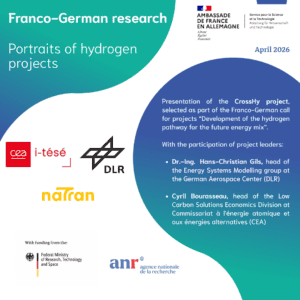
Within the joint call “Development of the hydrogen pathway for the future energy mix”, the German Federal Ministry of Research, Technology and Space (BMFTR) and the French Ministry of Higher Education, Research and Space (MESRE) via the French National Research Agency (ANR) are funding five innovative projects that provide solutions to key challenges in the development of a hydrogen economy. One of these projects is CrossHy (Cross-border Energy Infrastructure Implementation Pathways for Synergetic Solutions in French-German Hydrogen Supply), whose German and French coordinators, Dr.-Ing. Hans-Christian Gils and Cyril Bourasseau respectively, told us more about the aim of this project. Enjoy the read!
The research environment
1) Can you introduce yourself as a researcher?
Hans-Christian Gils: After my studies in physics at the universities of Constance, Padua and Hamburg, I joined the German Aerospace Center (DLR) as PhD candidate in energy systems modelling. Back then, my research was already on the modelling of multi-energy systems. I received my PhD from the University of Stuttgart in 2015. Since then, I contributed and managed broad variety of research projects, both national and international, on energy planning, sector coupling, resilience and energy data first as a postdoctoral researcher and since 2019 in my new role as head of the group “Energy Systems Modelling” at DLR.
Cyril Bourasseau: After completing my master’s degree in chemical engineering, I first worked as an R&D engineer in an international gas supply company before joining the Commissariat à l’énergie atomique et aux énergies alternatives (CEA) in 2010. For ten years, I contributed to various national and European CleanH2 collaborative projects related to techno-economic studies for energy systems and also to the Franco-German CatVic Project. From 2021 until recently, I headed a research lab for H2 SOC technology development at CEA. Last September, I joined the Institute for Research and Studies in Energy Economics (I-Tésé) of the CEA as the CrossHy project lead, replacing Valérie Seguin, who initially contributed to the proposal and acted as project leader
2) In what scientific environment do you evolve?
Cyril Bourasseau: I-Tésé is the energy economics research institute of the CEA. We work on low-carbon energy production and storage technologies, the availability of the resources required for these technologies, and changes in demand and consumption patterns. We approach our research systemically, leveraging the CEA’s historic expertise, creating numerical models, and utilizing the latest multicriteria analysis and system dynamics software to run complex scenarios. With a team of around thirty experts based in Paris-Saclay and Grenoble, we work closely with other CEA institutes, as well as with industry and public authorities, in France and abroad.
Hans-Christian Gils: The Energy Systems Analysis department of DLR is one of the biggest of its kind in Germany, and looks back to a history of more than 50 years. It is now part of the Institute of Networked Energy Systems, which covers energy systems research across all scales. The research team contributing to CrossHy is based in Stuttgart, and has a strong focus on the development and application of complex numerical optimization models for multi-energy system planning. Furthermore, it operates a broader modelling infrastructure for the data acquisition, management and analysis for these kinds of models. The research team is closely collaborating with other, for example more technology- and market-oriented colleagues as well as other specialized teams within our department, the institute, DLR and beyond.
Presentation of the project
3) Can you present us your scientific project in the field of hydrogen?
Hans-Christian Gils and Cyril Bourasseau: The goal of CrossHy is to analyse implementation pathways for hydrogen infrastructure within France and Germany. Our specific focus lies on cross-border regions. To enable this, we specifically work on the detailed modelling of hydrogen demand scenarios, the enhancement of energy system optimization methods, and the realization of a model coupling for detailed assessment of hydrogen infrastructure requirements. On this basis, we will perform a scenario-based analysis of infrastructure design for a resilient and economic hydrogen supply.
4) Can you present us the team behind the project (PIs, phd students, post docs etc)?
Cyril Bourasseau: A team of three young researchers is directly involved in the project bringing expertise and knowledge regarding H2 short-term and long-term multi sectors demand profiles, multi-energy modelling and simulation tools and techno-economic methodologies. Senior experts are also consulted when dealing with nuclear integration in future electricity mix or specific sector demand modelling. A post doc student will join I-Tésé in March 2026 for two years with the objective to favor exchange with our German colleagues at DLR.
Hans-Christian Gils: The modelling work for planning the transformation of the Franco-German energy system has so far been carried out primarily by one doctoral student at DLR. Due to the diverse topics and requirements of the project, a large team of scientists, both doctoral students and post docs, are also involved in the project on a selective basis. They all bring specific expertise and experience to make the project as successful and efficient as possible. This includes, for example, the areas of resource availability, scenario development, data management, optimization speed-up and stakeholder involvement.
Progress, results and applications (scientific, political, economic and social) of your project
5) After the launch of the projects in November 2024, what are the notable advances and results one year after the beginning of this adventure?
Hans-Christian Gils and Cyril Bourasseau: The first advance has been to learn to work together as Franco-German partners. This started by sharing methodologies, expertise and visions of the future multi-energy systems including the specific role that can be played by hydrogen and the challenges associated with its development. To this purpose, phases of intensive collaboration took place in 2025, such as:
- a joint modeler training week in Stuttgart in February to promote a mutual understanding of the models,
- the first developer sprint week in Paris in June where a proof-of-concept for coupling the energy system models of DLR (REMix) and CEA (ANTARES) was carried out,
- a first stakeholder workshop was held to collect needs and requirements of potential users of project outcomes.
Specific work has also been dedicated to discuss and consolidate H2 demand scenarios for the next 25 years at European level.
First analyses on the future infrastructure requirements for hydrogen in France and Germany have been performed and discussed within the consortium. The used REMix model is currently being refined and updated concerning different scenario assumptions and data inputs.
Additionally, as it is a specific objective of CrossHy, the teams carried out work on the definition of the interoperability of each applied modeling tool. Indeed, two different energy simulation and modeling tools at European level are planned to be used within the project: the open energy system modelling framework REMix (DLR) and the unit commitment and electrical dispatch modelling framework ANTARES (CEA).
6) What are the next big steps in the development of your project and how you plan:
- By the end of the project, in two years?
Hans-Christian Gils and Cyril Bourasseau: Currently, the project work focuses on the determination of model inputs for the hydrogen infrastructure analysis. This mostly concerns the development of new hydrogen demand scenarios, but also infrastructure and technology data. After this, the next major step will concern the realization and validation of the modelling pipeline beyond the already established demonstrator as well as the methodological work on model speed-up. Based on this, we will be able to perform the envisioned analyses on the implementation of hydrogen infrastructures in France, Germany and the especially the border regions, providing insights into solutions that are both cost-efficient and robust. In addition, we will shed light on the uncertainty related to the future hydrogen demand, varying supply options, changes in technological development and how they may impact the optimal system design and operation.
- After the project, in 5 years?
Hans-Christian Gils and Cyril Bourasseau: The long-term goal of our research is to provide in-depth knowledge to decision-makers, both from politics and the industry. With our research project, we aim to facilitate decision making regarding the adaption of the European energy system and the hydrogen integration.
This Franco-German initiative will also pave the way for further co-operation projects between CEA and DLR, as the challenges addressed are clearly cross-border. These future initiatives will undoubtedly benefit from the complementarity in expertise, teams and tools.
Crossing Borders: Opportunities and Benefits
7) What are the assets and advantages of working in cooperation with Germany/France on your project?
Hans-Christian Gils and Cyril Bourasseau: Our teams’ expertise and modeling tools are definitively complementary, thereby bringing a lot of value to the collaborative project. In addition, bringing French and German visions on the transformation of the energy system together within one and the same project is enriching and offers the prospect of producing unprecedented research results.
8) Do you notice any differences or peculiarities in this Franco-German bilateral work?
Hans-Christian Gils and Cyril Bourasseau: Of course, visions and methods can be different, but researchers are driven by their willingness to contribute to the understanding and solution of complex problems. In our case studies, generating knowledge related to complex multi energy problems is the common denominator of involved teams and is what drives the bilateral work.
The contribution of research, challenges and obstacles
9) In your opinion, what road does Europe still have to travel in terms of innovation and technology transfer to achieve its ambitions by 2030/2040 on hydrogen issues, and more broadly on decarbonized energy? In particular, what role does the transfer of research to industry and society play in achieving national, European and international decarbonization objectives?
Hans-Christian Gils and Cyril Bourasseau: While there is already quite some clarity about the most cost-effective technology options in other areas concerning the transformation of the energy system, there is still a high degree of uncertainty in potential fields of application for hydrogen and its derivatives. This applies to the industry as well as parts of the transport sector. As a result, there is a persistently high need for research to provide climate-friendly and cost-effective solutions for these energy applications as quickly as possible. For energy systems research, this results in the task of comprehensively evaluating various technology development pathways and infrastructure design options, while also taking into account the adaptability of the system if affected by disruptive changes. The role of future security of supply and system resilience also requires extensive analysis. Close cooperation between research, industry and politics is required to implement cost-effective, secure and socially acceptable solutions. To ensure that the transformation of the energy system will be a success, it must be seen as a task for our societies as a whole, not merely as an industrial or political project. This means that the involvement of society on the local level has a central role to play and that costs and benefits of the transformation must not be distributed one-sidedly. Nevertheless, it is primarily up to politicians to create the framework conditions for a successful transformation, including the promotion of research and development, creating suitable and efficient framework conditions as well as an honest public communication.
10) According to you and your team, how does your project contribute to the construction of a decarbonized Europe?
Hans-Christian Gils and Cyril Bourasseau: At European energy system level and the bilateral Franco-German cooperation, CrossHy contributes to the exploration and analysis of potential system development pathways until 2050. In doing so, it identifies robust and efficient implementation options for hydrogen infrastructures as part of future multi-energy systems. These can help to take the right decisions concerning infrastructure deployment and regulation, making the hydrogen integration into a cleaner, secure and affordable energy system a success.
The Office for Science and Technology extends its warmest thanks to Dr.-Ing. Hans-Christian Gils, Head of the Energy Systems Modelling group, at German Aerospace Center (DLR) and Cyril Bourasseau, Head of the Low Carbon Solutions Economics Division, at Commissariat à l’énergie atomique et aux énergies alternatives.
Réalisation du portrait : Loïs VAUGEOIS. Relecture : Siegfried MARTIN-DIAZ, Victor COULON. Avril 2026